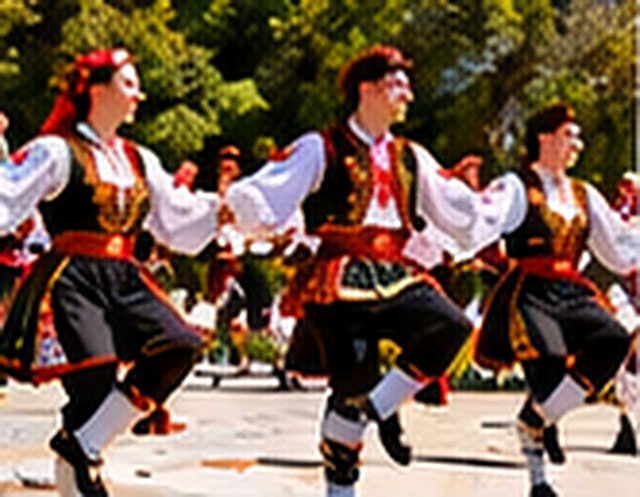
Kolo means “circle” and is used for a broad family of dances found across Croatia and neighboring regions. It is not a single choreography with one national tempo or costume. Depending on the locality, dancers may hold hands or link arms, form a closed circle or open chain, and follow repeating steps that strengthen a sense of collective participation. Kolo has appeared at weddings, celebrations and informal social gatherings.
Kolo means “circle” and is used for a broad family of dances found across Croatia and neighboring regions. It is not a single choreography with one national tempo or costume. Depending on the locality, dancers may hold hands or link arms, form a closed circle or open chain, and follow repeating steps that strengthen a sense of collective participation. Kolo has appeared at weddings, celebrations and informal social gatherings. The rhythm, footwork and musical accompaniment change by region. Some versions move in compact steps with subtle shifts of weight; others feature energetic stamping, turns or alternating directions. Tamburica music is associated with many eastern Croatian traditions, while other areas have different instruments or vocal practices. The circle is socially meaningful: it makes individuals part of a shared pattern while allowing local variations and personal expression. When watching a kolo performance, look beyond the shape of the circle. Notice how dancers enter and leave, who leads a change, how steps respond to musical phrases, and which village or region the group represents. DANZO treats Slavonian Kolo and Nijemo Kolo as distinct regional practices rather than describing every Croatian circle dance as the same tradition.