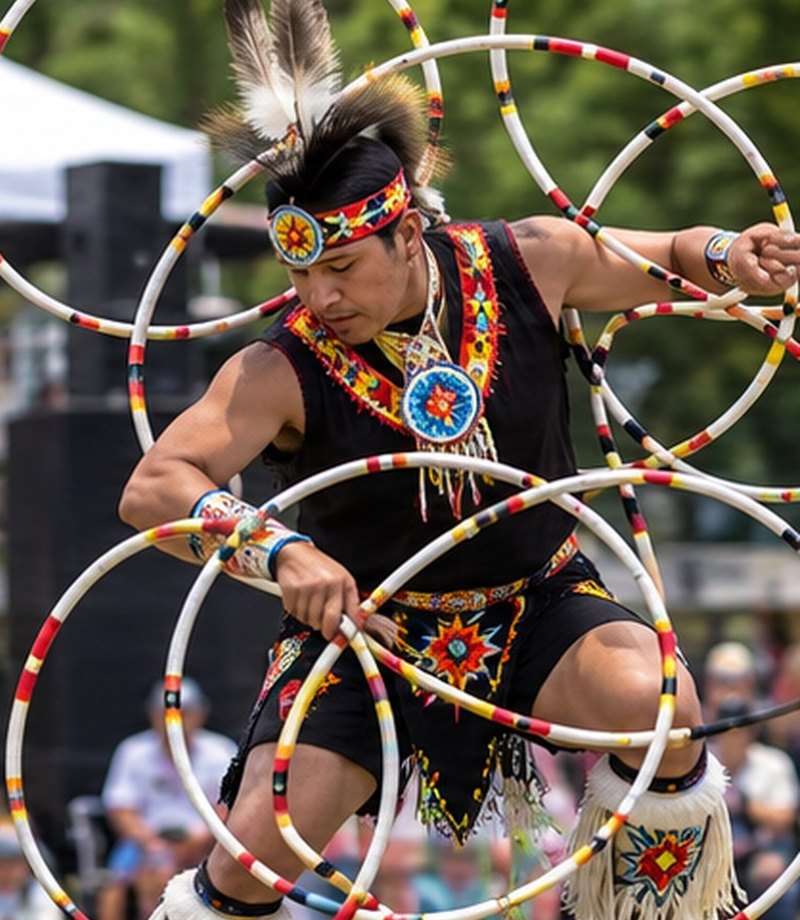
A hoop dancer starts with one hoop and adds more — sometimes thirty or more — weaving them around the body into shapes such as an eagle, a butterfly, a flower or a globe, all while dancing in time to the drum. The circle represents the cycle of life, with no beginning and no end.
Hoop dancing has roots in several Nations; many teachers trace it to healing and storytelling traditions, and today it belongs to the wider intertribal world of exhibition and competition. The World Championship Hoop Dance Contest, held at the Heard Museum in Phoenix since 1991, attracts many Canadian dancers. Canada has produced some of its greatest champions. Lisa Odjig, an Odawa and Ojibwe dancer from Ontario, was the first woman to win the world title, in 2000, and won again in 2003. Quentin Pipestem (Tsuut’ina), Alex Wells (Lil’wat) and Cree dancer Dallas Arcand from Alberta, a three-time world champion, also took the crown. Hoop dance is often performed at schools, festivals and the Calgary Stampede to share teachings with the public.