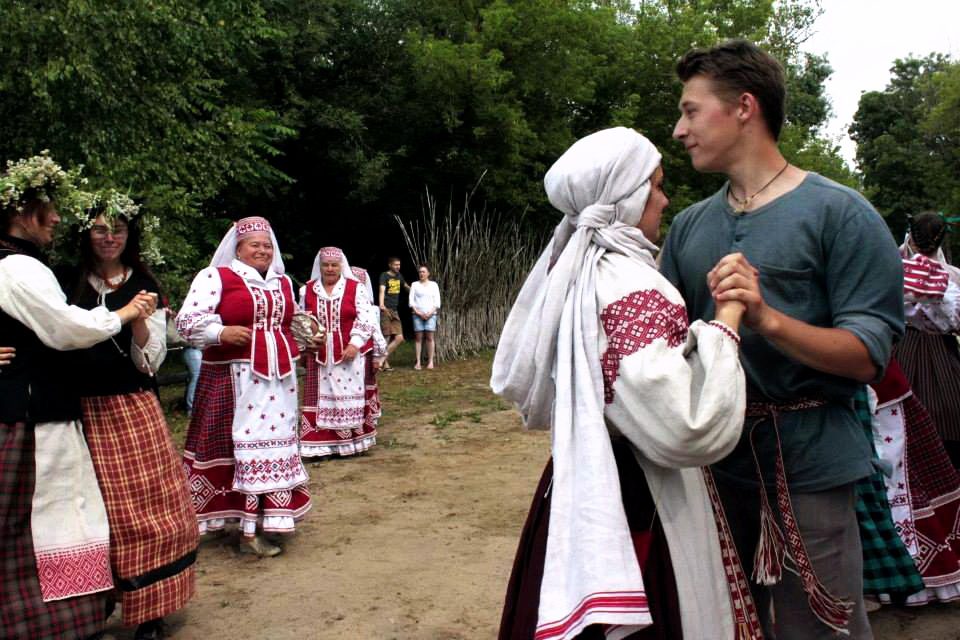
Myatselitsa — Metelitsa in Russian, 'the snowstorm' — whirls like a winter blizzard: dancers spin, weave chains and swirl in and out of spirals. In 1852 it became the first Belarusian folk dance ever performed in a theatre.
Myatselitsa belongs to the illustrative dances of Belarus — dances that paint a picture, where gesture and play matter as much as steps. Here the picture is a blizzard: couples spin on the spot, lines of dancers wrap and unwrap like gusts of wind, and chains weave under arches of raised hands until the whole floor seems to swirl with snow. It was danced on long winter evenings, when field work stopped and young people gathered for music and games. Myatselitsa also has a special place in theatre history. In 1852 the writer Vintsent Dunin-Martsinkevich staged in his own Minsk theatre the comic opera Sialanka (The Peasant Woman, also called Idyll), with music by Stanisław Moniuszko and Kanstantsin Kryzhanovsky; its Myatselitsa is regarded as the first use of a Belarusian folk dance on a theatre stage. Half a century later the dance was in the repertoire of Ignat Buinitsky's troupe, the first Belarusian professional company, which toured with songs and dances from 1907. Today folk-stage ensembles present Myatselitsa as a brilliant winter showpiece, often with dancers in white and silver and with fast turns that test the dancers' stamina; children's groups love it for its chases and spirals.