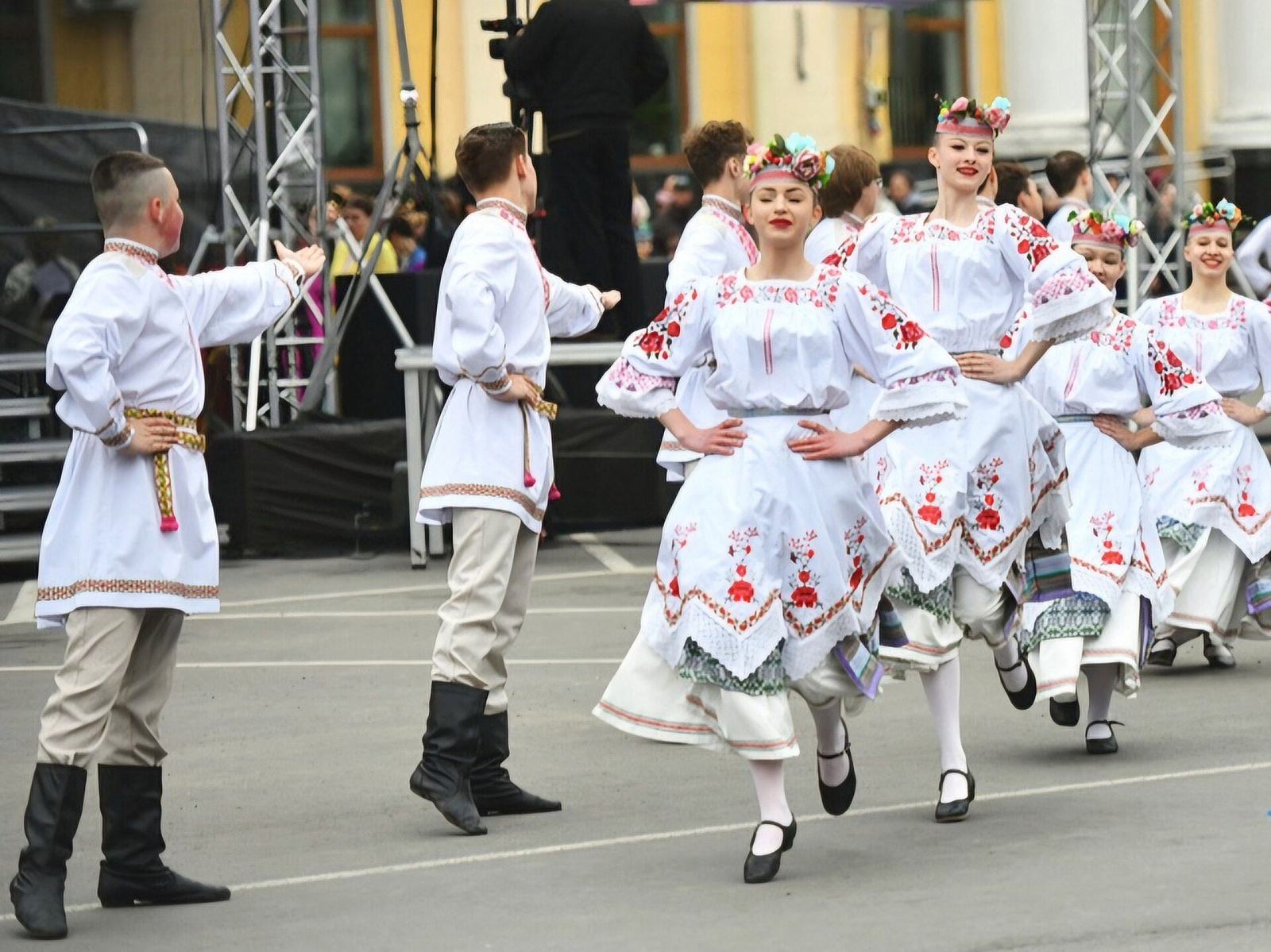
Lyavonikha is the most popular Belarusian folk dance: couples run, gallop, stamp and spin to a merry song about Lyavon and his wife. Any number of couples can join, so it was the main dance at village weddings and winter evening gatherings.
Lyavonikha grew out of a song. Its verses are a teasing dialogue between Lyavon — the Belarusian form of the name Leon — and his wife Lyavonikha, and the dancers circled around the singers, breaking into couples that whirled on the spot. In the villages it was the central dance of weddings, and at vyachorki, the winter evening gatherings where young people spun yarn, sang and danced, it was spiced with quick, cheeky rhyming verses that turned it into a playful contest. The steps are simple but fast — running steps, gallops, stamps and claps in a lively 2/4 — and the figures change freely: circles, lines, stars, arches of raised hands and couples turning arm in arm. In some districts dancers entered the centre one by one to show off a solo. Local names such as Krutukha or Krutsyolka come from all that spinning. In the 20th century the choreographer Kanstantsin Aleksyutovich shaped Lyavonikha for the stage, and his version became the grand finale of the first Belarusian ballet, Salavei (The Nightingale, 1939); at the festival of Belarusian art in Moscow in 1940 it was danced by a hundred couples. Later choreographers such as Larysa Lyashenko created their own versions, and today every Belarusian folk ensemble, from the State Dance Ensemble to village and children's groups, keeps it in its repertoire.