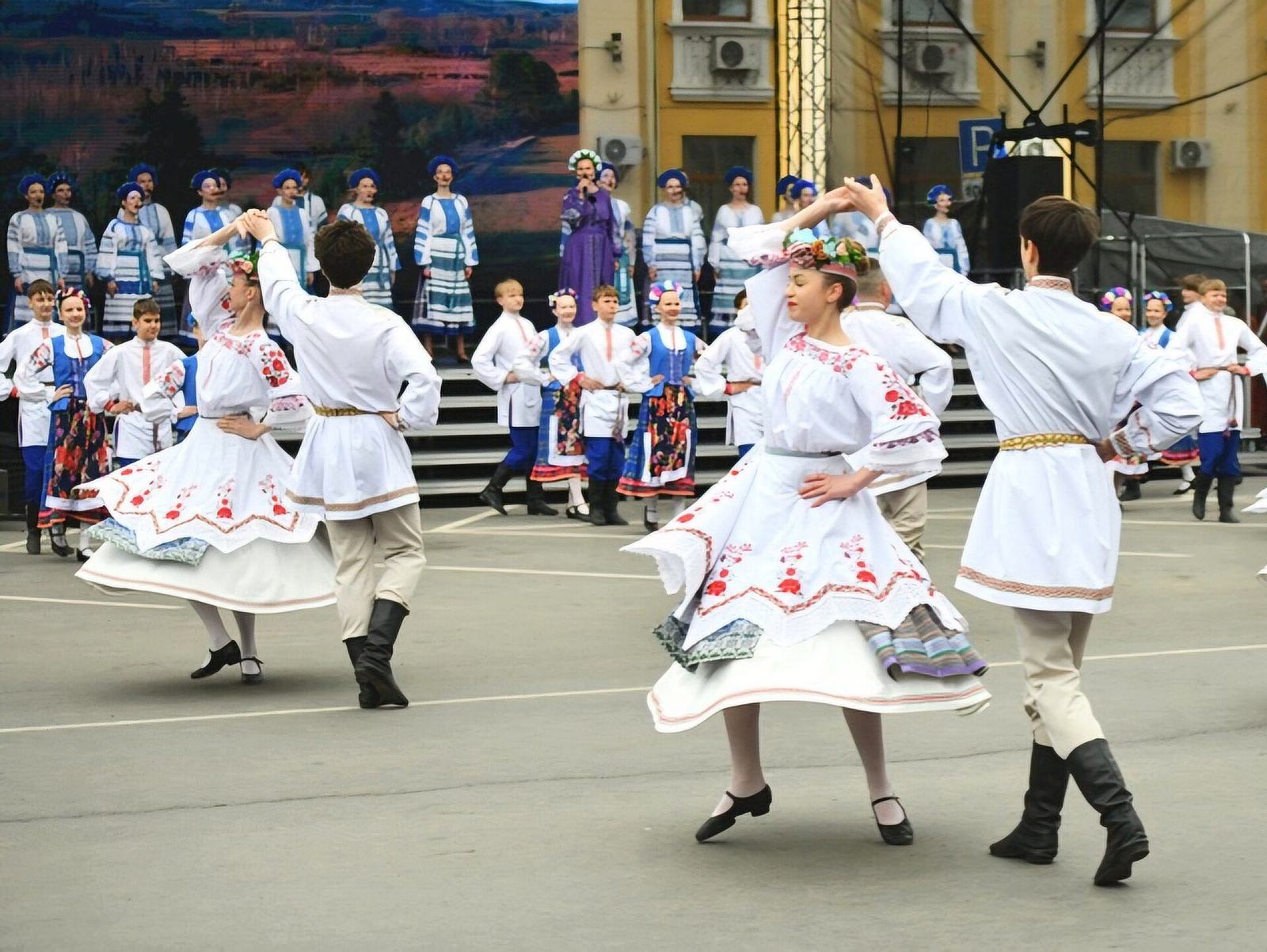
Kryzhachok is a fast couple dance whose figures draw geometric patterns on the floor. Its name is linked both to kryzhak, the wild drake, and to kryzh, the cross formed by the dancers — and it is almost as popular as Lyavonikha.
Belarusian folk dances are often grouped into three families: illustrative dances that act out a scene, game dances, and ornamental dances whose beauty lies in the pattern. Kryzhachok is the classic ornamental dance. Folk etymology offers two origins for its name: the kryzhak, the wild drake, whose quick, bobbing movements the dancers imitate, and the kryzh, the cross — because couples stand crosswise and swap places in criss-cross lines. In some places it is even called Kruzhachok, 'little circle', as most of its figures turn round. Every region had its own version. Around Vitebsk couples formed a cross and travelled round in light hops; in the Brest area four couples stood crosswise and took turns passing under the arch made by the opposite pair; near Grodno four young men crossed arms in the centre and walked round while the girls ran back and forth to them; in the Mogilev region couples danced with crossed arms and high, springy hops. In the 1920s Kanstantsin Aleksyutovich turned Kryzhachok into a stage piece: an emotional opening, a slow lyrical solo for one or two couples against the background of the others, and a fast, playful finale with rapidly changing patterns. His version appeared in the ballets Salavei and Knyaz-vozera, and the later staging by Larysa Lyashenko became the one most Belarusian ensembles dance today.