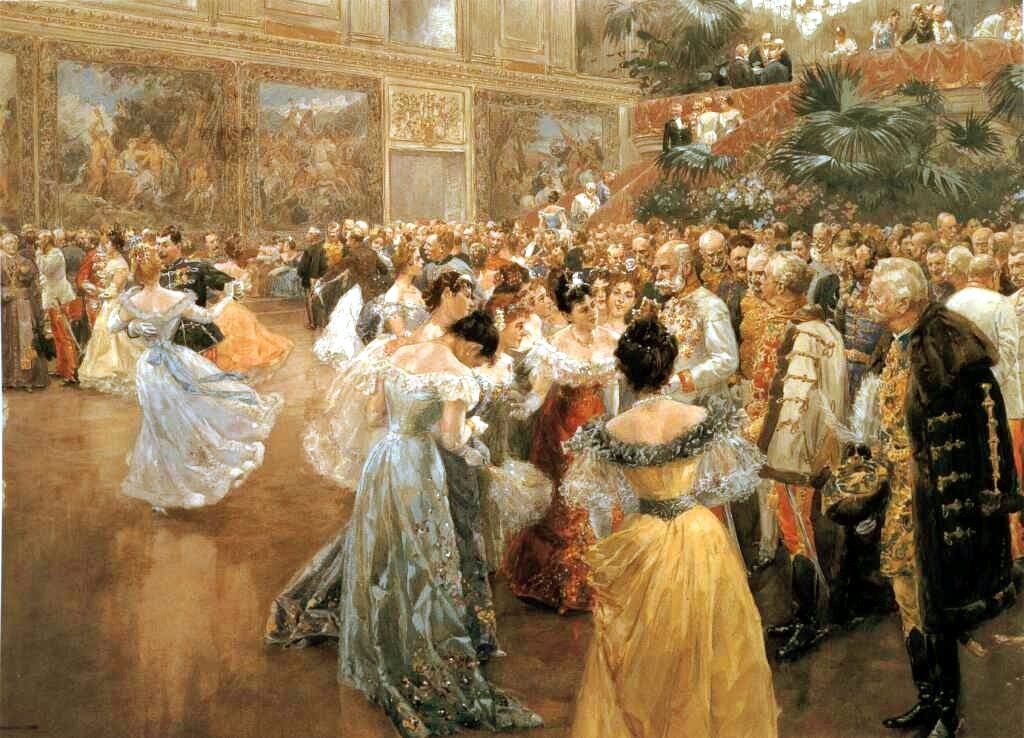
At midnight, Viennese balls stop waltzing and line up for the quadrille: couples face each other in long columns while a dance master calls the figures in French. It is the ball's great shared moment, and with the opening polonaise and the 'Alles Walzer!' call it forms the ritual of every Viennese ball.
The quadrille came to Vienna from Paris in the early 19th century: a dance for four couples arranged in a square, made of several short figures in which partners advance, retreat, cross over and change places. Viennese composers loved it. Johann Strauss II wrote dozens of quadrilles on melodies from popular operas and operettas, and his Fledermaus-Quadrille, built on tunes from his operetta Die Fledermaus (1874), is still the one most Viennese balls dance. At a modern ball the quadrille is the Mitternachtsquadrille, the midnight quadrille. The guests form long double columns across the hall, and a dance master on the stage calls each figure in French — 'En avant!', 'Changez les dames!', 'Tour de main!' — with growing speed, until the last galop dissolves into laughter and applause. It is the moment when strangers dance together and the whole ball becomes one dance. The quadrille is part of a fixed ritual. A ball opens with a procession of debutante couples — young women in white gowns and young men in tailcoats — who dance a polonaise (often Carl Michael Ziehrer's Fächerpolonaise, the 'fan polonaise') and an opening waltz; then the master of ceremonies calls 'Alles Walzer!' and everyone may dance. At the Vienna Opera Ball, around 300 debutants open the evening and quadrilles are danced at midnight and again in the early hours. Viennese dance schools such as Elmayer teach the Quadrille Française to anyone who wants to be ready.