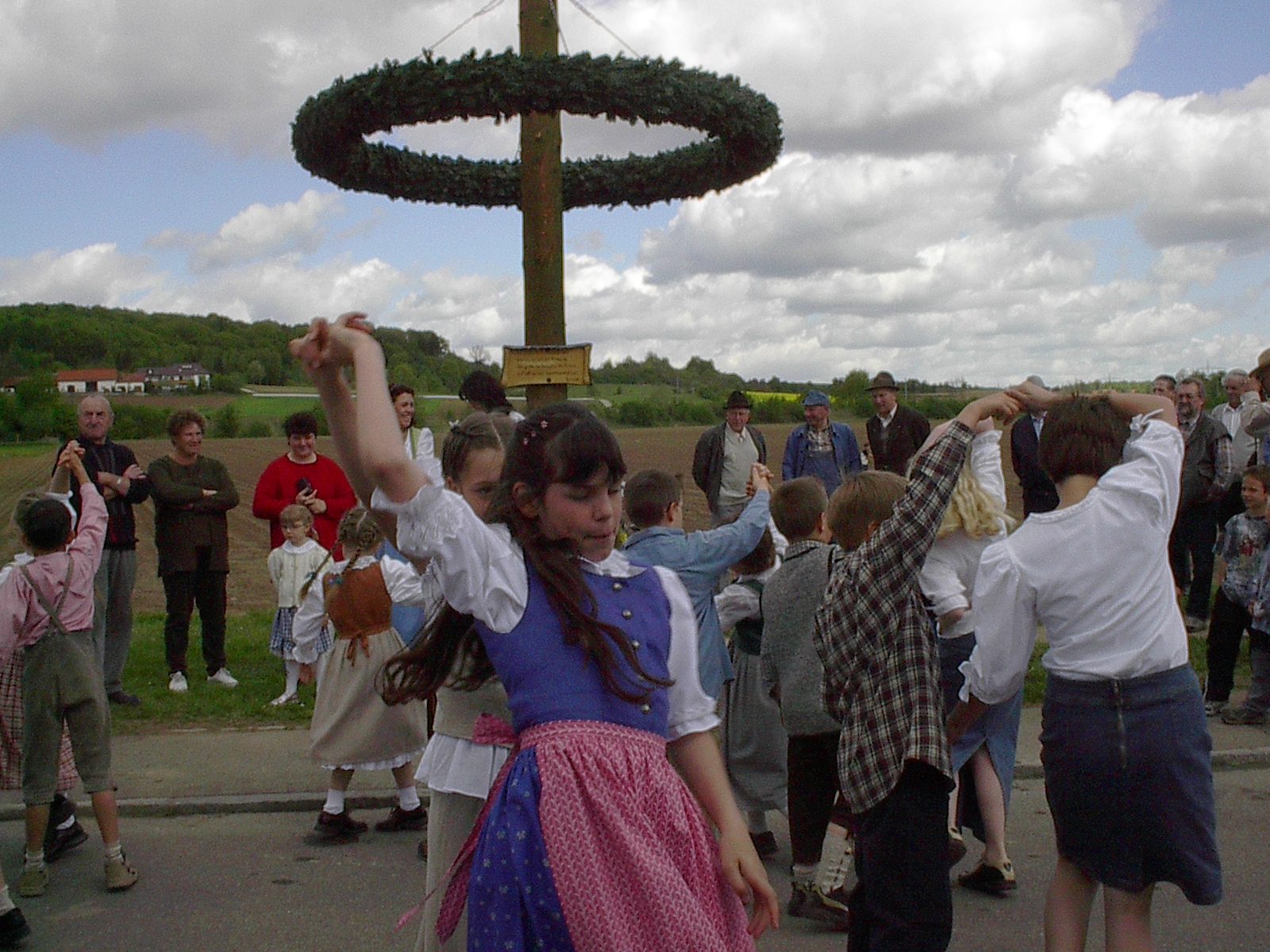
In the Bandltanz ('ribbon dance') pairs of dancers each hold a long coloured ribbon fixed to the top of a pole. Weaving in and out around each other, they plait the ribbons into a bright pattern down the pole — and then dance the figure backwards to undo it. Folk-dance and rural-youth groups perform it at May festivals, church fairs and harvest celebrations.
Ribbon and pole dances belong to the great family of European spring customs. In Austria the maypole (Maibaum) — a tall, stripped tree trunk crowned with a green top and garlands — is raised in village squares on the last day of April or on 1 May, often after nights of guarding it from neighbouring villages who try to steal it. Around such poles, and around smaller portable 'Bandlbäume' carried onto a stage or dance floor, the Bandltanz is danced. An even number of dancers, usually in couples, stand in a circle, each holding the end of a ribbon. As the music plays, half the dancers move clockwise and half anticlockwise, passing alternately inside and outside one another; with every round the ribbons are woven tighter until the pole is wrapped in a coloured plait or a criss-cross pattern. Then the dancers turn round and dance the same path backwards until the ribbons hang free again — a test of concentration, because a single wrong turn knots everything. Other figures make a 'spider's web' or a spiral. The music is a simple, steady polka, march or Ländler on the accordion or a village band. Today the Bandltanz is above all a dance of community and youth: rural-youth (Landjugend) and folk-dance groups, often children, show it at May festivals, Kirtage, harvest thanksgivings and folk-culture festivals such as Graz's Aufsteirern, keeping alive the cooperative spirit that the Austrian folk-dance movement — on the national intangible-heritage inventory since 2010 — puts at its centre.