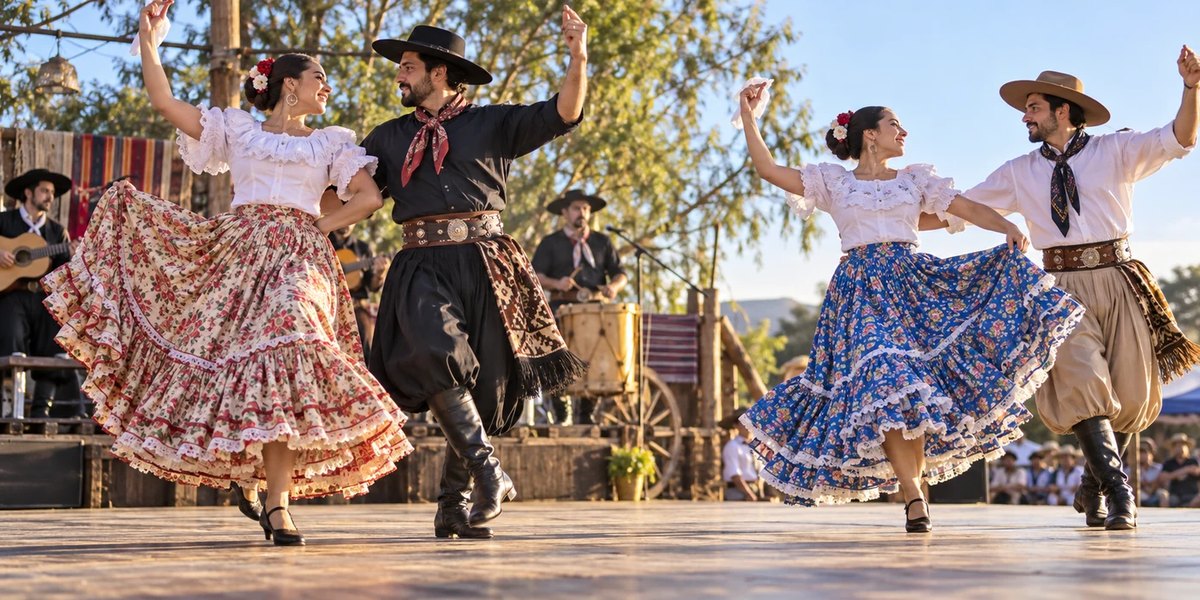
The chacarera is Argentina’s most popular folk dance. Couples face each other and perform a sequence of figures — advance and retreat, turns, the man’s zapateo (footwork) answered by the woman’s zarandeo (skirt swirling), and a final ‘coronación’ — to guitar, violin and the deep bombo legüero drum. It is danced at peñas, family parties and festivals all over the country.
The chacarera comes from Santiago del Estero in the north-west, a province of Quechua-speaking communities, farms (chacras — hence the name) and great musicians. It mixes Spanish dance forms with Indigenous and criollo musical traditions, and its rhythm combines 6/8 and 3/4, giving it an irresistible swing. In 1921 Andrés Chazarreta, the ‘patriarch of folklore’, brought his troupe of Santiago musicians and dancers to Buenos Aires, making the chacarera known nationally. Later groups such as Los Hermanos Ábalos, Los Manseros Santiagueños and the Carabajal family, and artists like Mercedes Sosa, made it a symbol of Argentine folklore. Variants include the chacarera doble and the ‘chacarera trunca’, with its syncopated ‘cut’ rhythm.