··EN · ES · FA
Tap a region to read its story
Swipe the timeline
Each place connects landscape, history and living tradition. Always check current programmes before visiting.
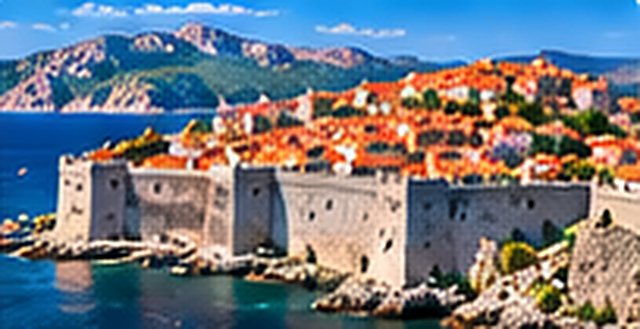
Dubrovnik was a maritime republic and a meeting point of Adriatic, Mediterranean and European cultures. Its walled old town is a UNESCO World Heritage site, but the city’s heritage also lives beyond stone buildings—in local songs, seasonal celebrations, traditional dress and social dances. The surrounding villages of Župa dubrovačka, Konavle and the islands preserve their own customs, which should not be treated as one uniform Dubrovnik style. Folklore here belongs to communities, not merely to performances arranged for visitors.
The most recognizable dance of the Dubrovnik area is Linđo, related to the older poskočica, a lively dance of couples within a circle. A lijerica, a small three-string bowed instrument, provides a distinctive, driving sound. A dance leader calls or directs figures as couples change positions, turn and respond to one another. The Linđo Museum traces the name to Nikola Lale, a renowned nineteenth-century lijerica player nicknamed Linđo. The dance is a social conversation as much as a display of technical skill.
Split grew around the late Roman Palace of Diocletian, built around the turn of the fourth century. Its historical complex is recognized by UNESCO and layers Roman, medieval and later architecture within a living city. Split also connects the Dalmatian coast with inland communities, so its cultural identity is broader than the palace or a single dance.
The region’s traditions include social dances, coastal songs and community celebrations. Dalmatian klapa multipart singing, inscribed by UNESCO in 2012, is an important musical tradition, although it should not be described as a dance. Folklore performances in Split may present repertory from several Dalmatian localities, each with different costume and movement practices.
Zagreb, Croatia’s capital, is a major center for cultural institutions, dance education and the documentation of folklore. Its urban history includes Central European influences alongside traditions brought from different Croatian regions. The city’s performance calendar can feature ballet, contemporary dance, community folklore and touring ensembles, which should be treated as distinct artistic practices.
The national folk dance ensemble LADO was founded in Zagreb in 1949. Its repertoire includes choreographies and musical works from across Croatia, researched and arranged for professional performance. The city also supports museums, archives, theaters and educational programs that can help visitors understand the relationship between regional traditions and staged national presentation.
Korčula is an Adriatic island with a distinctive tradition of ceremonial and theatrical sword dances. Its old town, coastal villages and community associations preserve practices that link performance with local identity. The island is particularly famous for Moreška, while Kumpanija and Moštra represent related but different local traditions.
Moreška stages a dramatic conflict with two groups of sword-bearing dancers. Kumpanija is associated with village brotherhoods and group sword formations, while Moštra is practiced in Žrnovo. Their choreographic structures, histories and local contexts differ; they should not be grouped under one generic label of “sword dance.”
Plitvice Lakes National Park is known for its interconnected lakes, waterfalls and forested karst landscape. It is a UNESCO World Heritage natural site, not a dance tradition or a performance venue in itself. DANZO includes it to situate Croatian cultural travel within the country’s varied landscapes.
The wider region of Lika has its own rural history and cultural practices, but it would be inaccurate to assign a single famous national dance to the lakes. Traditional music, dress and social dancing are best explored through communities, museums and cultural groups in the surrounding area, rather than through scenic photographs alone.
Rovinj, also known as Rovigno, is an Adriatic town in Istria whose cultural life reflects Croatian and Italian linguistic and maritime histories. Its narrow streets, fishing traditions and local celebrations offer a setting for understanding the relationship between place, music and community identity.
Istrian dance heritage includes Balun and other locally documented forms. Traditional instruments such as sopile are important in parts of the peninsula, although they should not be assumed to accompany every performance in Rovinj. The town also has a strong heritage of seafaring and song, preserved through community initiatives.