··EN · ES · FA
Tap a region to read its story
Swipe the timeline
Colombian dance was not born in one place or one moment. It grew from many peoples and landscapes, through encounters that were often unequal and painful, and through the creativity of communities that kept their music alive.
Long before the modern Colombian state, Indigenous peoples lived across the Caribbean lowlands, the Andes, the Pacific and Amazon forests, the plains and the islands. Music and movement belonged to ceremonial calendars, farming cycles, rites of passage and community meetings.
There was never one ‘pre-Columbian dance’ shared by all. Respectful documentation begins with the names and wishes of each community — for example the Wayuu of La Guajira, whose yonna is a ceremonial dance with its own meaning.
From the sixteenth century, Spanish colonial rule and the forced transport of enslaved Africans transformed life in what is now Colombia. These encounters were shaped by violence and inequality; cultural mixing should never erase that history.
Yet Afro-descendant communities preserved and reinvented drumming, song, movement and collective celebration. Free communities such as San Basilio de Palenque kept their own language and traditions, recognised by UNESCO in 2008.
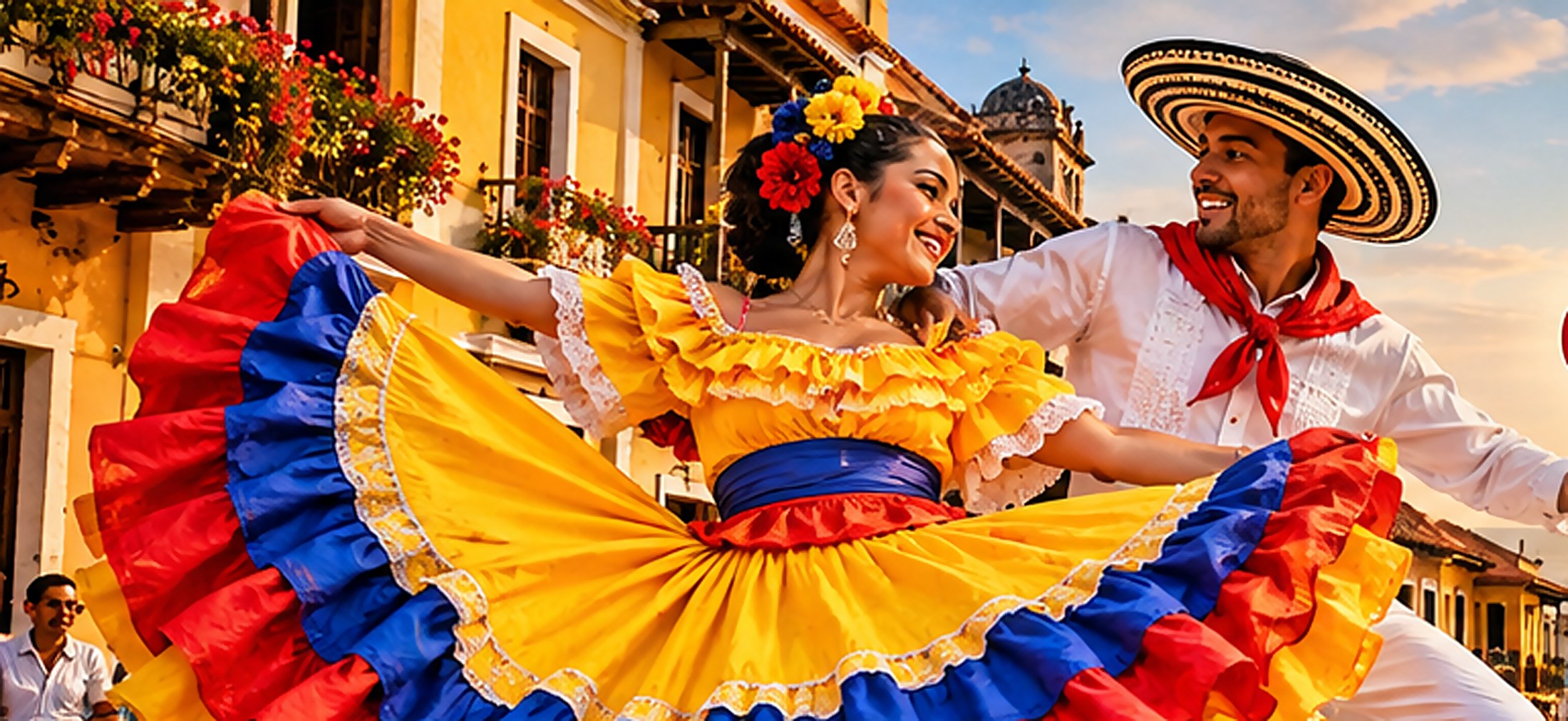
In the lower Magdalena basin and on the Caribbean coast, cumbia developed as music, dance and social life through exchanges among Indigenous, African and European traditions. Gaitas, the caña de millo, drums and circling couples are among its features.
Through radio, records and orchestras, cumbia travelled far beyond Colombia. The Ministry of Culture stresses that it remains a living practice of communities, not only a costume or a national emblem.
Along the southern Pacific coast, Afro-Colombian communities built a musical world around the marimba de chonta, cununo and bombo drums, guasá rattles and voices. Currulao is the festive dance; other chants belong to devotion and mourning.
UNESCO recognised these marimba traditions in 2015, together with Ecuador’s Esmeraldas, highlighting transmission through families and elders. Chocó, further north, has its own chirimía and abozao repertoires.
In the Andes, bambuco, pasillo, guabina, torbellino and Huila’s sanjuanero combine local fiestas, song, courtship choreography and string instruments such as the tiple and bandola. Each department — Boyacá, Santander, Tolima, Huila — has its own style.
Across the eastern Llanos, joropo developed in a landscape shared with Venezuela. Harp, cuatro and maracas accompany fast zapateo, and the plains’ work songs were recognised by UNESCO in 2017.
Carnivals gather many traditions at once. The Barranquilla Carnival (UNESCO 2008) brings congo, garabato, paloteo and mapalé to the streets; Pasto’s Carnaval de Negros y Blancos (UNESCO 2009) is famous for masks and community art.
In the twentieth century, cities created new scenes: Cali made salsa its own, Cartagena gave birth to champeta, and folkloric ballets and schools carried regional dances to national and international stages.