··EN · ES · FA
Tap a region to read its story
Swipe the timeline
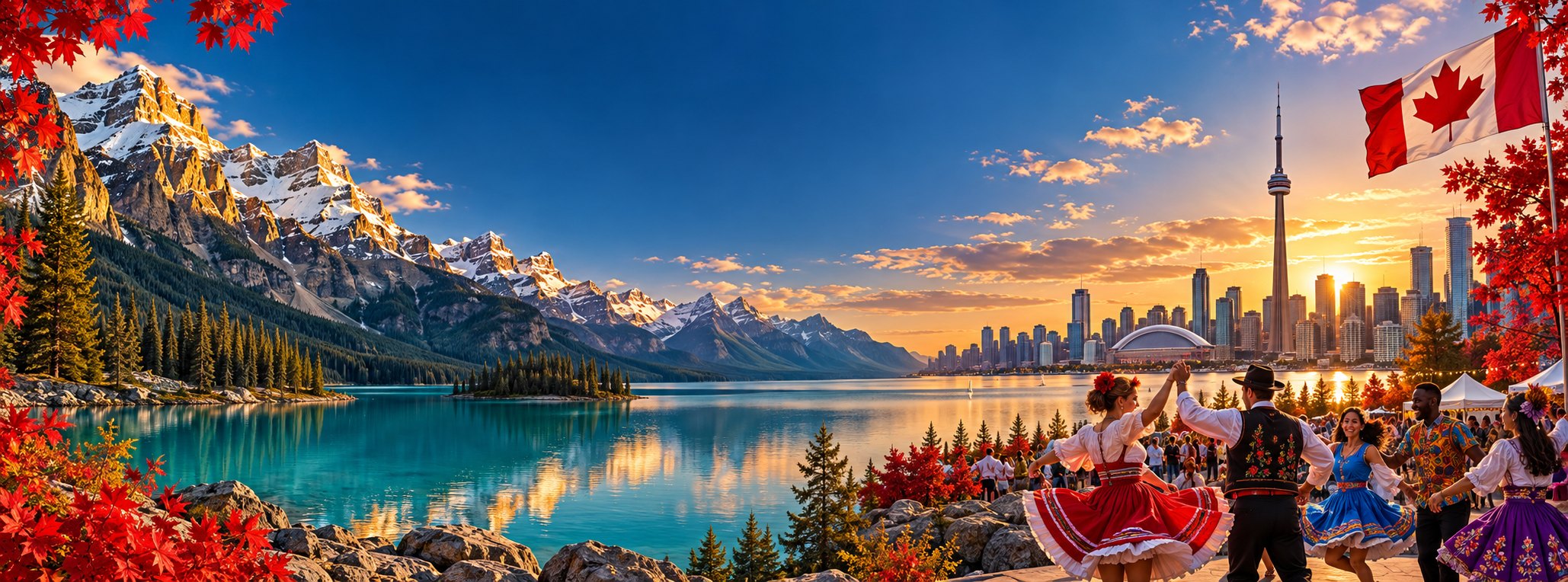
Ten places where Canadian dance lives: Toronto and Montréal’s stages, Old Québec, Winnipeg’s Métis and Ukrainian heritage, the Calgary Stampede, Cape Breton’s ceilidhs, Alert Bay’s Big House, Vancouver, Banff and Niagara Falls.
Canada’s largest city is home to the National Ballet of Canada, Canada’s National Ballet School on Jarvis Street, Toronto Dance Theatre and Dance Arts Institute in Cabbagetown, and dozens of studios for every style.
More than half of Toronto’s residents were born outside Canada, so its festivals — Caribbean Carnival, the Toronto Ukrainian Festival, Harbourfront’s summer programs — offer dances from all over the world.
Montréal’s dancers and choreographers — Édouard Lock, Marie Chouinard, Louise Lecavalier, Margie Gillis — made the city a global capital of contemporary dance. The Wilder building gathers the École de danse contemporaine, Agora de la danse and other organizations under one roof.
Les Grands Ballets perform at Place des Arts, street dancers gather at the JOAT festival, and trad bands bring the gigue to bars and festivals.
Founded in 1608, Québec City is the cradle of French America and its walled old town is a UNESCO World Heritage Site. Fiddle music, gigue and songs are part of its festivals and of the veillée tradition.
Every February the Carnaval de Québec fills the streets with parades, snow sculptures, music and dancing in the cold.
Winnipeg grew at The Forks, where the Red and Assiniboine rivers meet — the historic heart of the Métis Nation. In February, Festival du Voyageur in the French quarter of Saint-Boniface celebrates fur-trade heritage with fiddling, jigging and snow sculptures.
The city is also home to the Royal Winnipeg Ballet, the Manito Ahbee powwow and Folklorama, which since 1970 has filled August with dozens of cultural pavilions.
Every July the Calgary Stampede’s Elbow River Camp brings together the Treaty 7 First Nations — Siksika, Piikani, Kainai, Tsuut’ina and Stoney Nakoda — with tipis, powwow dancing and hoop dancers such as Dallas Arcand.
Calgary also has Alberta Ballet and Decidedly Jazz Danceworks; Edmonton is home to the Ukrainian Shumka Dancers and their school, and nearby Vegreville holds its Pysanka Festival every July.
Cape Breton’s Gaelic-speaking settlers kept a style of step dancing and fiddling that is now admired worldwide. In summer, ceilidhs and square dances in small community halls — Glencoe Mills, West Mabou, Judique — welcome visitors, and the Gaelic College at St. Ann’s (founded 1938) offers classes.
In October the Celtic Colours International Festival (8–16 October 2027) holds concerts, dances and workshops across the island during the autumn colours.
On Cormorant Island off northern Vancouver Island, Alert Bay is home to the ’Namgis First Nation. The U’mista Cultural Centre (1980) displays the potlatch regalia seized in 1921 and later returned, and tells the story of the ban and the fight to bring the treasures home.
In summer, cultural dance performances are sometimes offered to visitors in the Big House; potlatches themselves are community ceremonies, attended by invitation.
Vancouver lies on the unceded territories of the Musqueam, Squamish and Tsleil-Waututh nations, whose cultures are visible in public art and events. The Museum of Anthropology at UBC holds great Northwest Coast collections.
The city is a centre of contemporary dance — The Dance Centre, Ballet BC, Kidd Pivot — and street dance, with drop-in classes at Harbour Dance Centre on Granville Street.
Canada’s first national park, Banff lies in the traditional lands of the Stoney Nakoda, Blackfoot and Tsuut’ina nations. Visitors can learn about this history from Indigenous-led tours and programs.
The Banff Centre for Arts and Creativity is an internationally known residency where dancers and choreographers — including Kidd Pivot — create new work.
Niagara Falls is one of Canada’s best-known natural landmarks, on the border with the United States and on the traditional territory of Haudenosaunee and Anishinaabe peoples.
The waterfall is not a dance tradition, but a trip can combine it with Toronto’s stages, summer festivals in Niagara-on-the-Lake and the Six Nations of the Grand River powwow nearby.