··EN · ES · FA
Tap a region to read its story
Swipe the timeline
Canada’s dance history is not a single story. It is the story of more than 600 First Nations, the Inuit and the Métis; of French and British colonists and the communities they displaced; of waves of immigrants who brought their dances with them; and of artists who turned all this into new forms. It includes painful chapters — the banning of Indigenous ceremonies — as well as remarkable revivals.
Long before Canada existed, the peoples of this land danced to give thanks, mark the seasons, tell stories, heal and pass on names and rights. Plains nations held Sun Dances and circle dances; Pacific nations danced crests and stories in potlatches; Haudenosaunee communities in the east kept social dances such as the Smoke Dance; and Inuit families in the Arctic drum-danced in winter gathering houses.
Each nation’s dances are distinct, and some are sacred: they are shared only within the community or with permission. An honest dance atlas names the nation whenever possible and describes ceremonies only in publicly appropriate terms.
In 1884 Parliament amended the Indian Act to outlaw the potlatch from 1885; in 1895 the ban was widened to other ceremonies, including Sun Dances and give-away dances. Officials and missionaries also pressured communities, and residential schools separated generations of children from their languages, songs and dances.
Communities resisted: they danced in secret, held gatherings at fairs and rodeos, and kept regalia hidden. In 1921 officials seized masks after a Kwakwaka’wakw potlatch at Village Island; most of them came home decades later and are now at the U’mista Cultural Centre. The bans were finally dropped in 1951, and powwows, potlatches and round dances grew again.
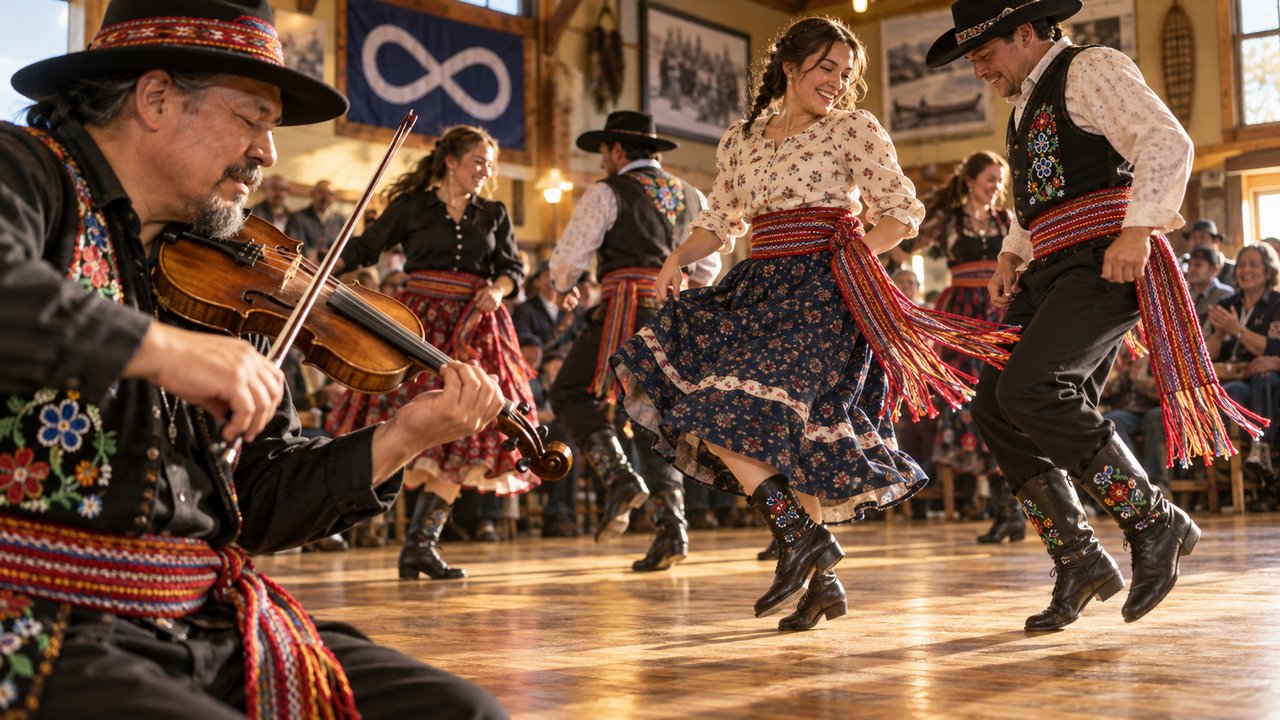
Around the fur trade of the 18th and 19th centuries, the Métis emerged as a distinct people with their own language (Michif), sashes, beadwork and fiddle music. At the Red River settlement, Indigenous footwork met Scottish and French-Canadian fiddle tunes, and the Red River Jig was born.
Led by Louis Riel, the Métis resisted Canadian expansion in 1869–70 and 1885. Their culture was later marginalized, but from the 1970s festivals such as Back to Batoche Days and Festival du Voyageur put jigging back in the spotlight; in 1982 the Constitution recognized the Métis as one of Canada’s Aboriginal peoples.
French colonists in the 17th and 18th centuries brought contredanses, quadrilles and step dancing. In rural Québec and Acadia, long winters made the veillée — an evening of fiddle, songs, stories and dancing — the heart of social life.
Irish and Scottish neighbours added reels and jigs, and Québec developed its own repertoire, with a câleur calling the figures in French and fiddlers keeping time with their feet (podorythmie). The 1970s folk revival brought the gigue back to stages and festivals.
From the late 18th century thousands of Highland Scots settled Nova Scotia, Cape Breton Island and eastern Ontario. In Cape Breton they kept an old, close-to-the-floor style of step dancing that later faded in Scotland, while Highland Games, starting at Antigonish in 1863, made the Highland Fling and Sword Dance competitive sports.
Irish immigrants, lumber camps and kitchen parties shaped Ottawa Valley step dancing, and Newfoundland developed its own set dances and ‘kitchen party’ culture. The Gaelic College, founded at St. Ann’s in 1938, and the Celtic Colours festival (since 1997) keep these traditions strong.
From 1891 Ukrainian families settled the Prairies, and in the 1920s Vasile Avramenko founded Ukrainian dance schools across the country. Ensembles such as Edmonton’s Shumka (1959) turned folk dance into spectacular theatre, and festivals in Dauphin and Vegreville celebrate it every summer.
Canada’s official policy of multiculturalism (1971) encouraged communities to share their heritage. Winnipeg’s Folklorama, first held in 1970, now presents dozens of cultural pavilions every August, and Caribbean carnival, bhangra, Chinese lion dance, Filipino tinikling and many other traditions are part of everyday Canadian life.
The Winnipeg Ballet Club (1939) became the Royal Winnipeg Ballet in 1953. Celia Franca founded the National Ballet of Canada (1951) and, with Betty Oliphant, Canada’s National Ballet School (1959); Ludmilla Chiriaeff created Les Grands Ballets Canadiens in Montréal (1957).
Modern dance followed: Winnipeg’s Contemporary Dancers (1964), Toronto Dance Theatre (1968) and, from the 1980s, Montréal’s explosion of daring companies. Choreographers such as Édouard Lock, Marie Chouinard and Crystal Pite made Canadian dance famous worldwide.
Hip-hop arrived in the early 1980s and was embraced by young people in Canada’s diverse cities. Crews, battles, studios and festivals such as Montréal’s JOAT built strong scenes in breaking, popping, locking, house, krump and waacking.
In August 2024, Vancouver b-boy Philip ‘Phil Wizard’ Kim won the first men’s Olympic breaking gold medal in Paris — a landmark for street dance in Canada.