··EN · ES · FA
Tap a region to read its story
Swipe the timeline
Ethnographers divide Belarus into historical regions — Palesse in the south, the Neman lands in the west, Central Belarus, Paazerje (the Lakeland) in the north and Padniaprouje along the Dnieper in the east — and each keeps its own songs, rites and ways of dancing. This page follows the six present-day regions. The dance chips show the stage dances you are most likely to meet there today, not their place of origin: most Belarusian dances are danced all over the country. Use the map to choose a region.
The south-west of Belarus belongs to Palesse, a land of rivers, marshes and forests whose villages kept their rites longer than most. Here folklorists found the Kust, “leading the bush”: in late spring a troop of girls led by a girl dressed in greenery and flowers went from house to house singing. Described in 19th-century periodicals and thought to be extinct, it was rediscovered in the second half of the 20th century in the Pinsk district; in Tyshkavichy, in the Ivanava district, a newcomer tried to revive it, but after she left only the song remained.
Palesse is also a land of spring round dances. Recordings made in the Pinsk and Stolin districts between the 1960s and 1980s preserve the song-dance “Oj, nie rasci, kropie”, led as a round dance at Easter, and variants of the round-dance game Kazyol, “the Goat”, in which girls form a circle and one girl in the middle acts out the words of the song.
In the Belavezha National Park — part of the cross-border Białowieża Forest, a World Heritage Site since 1992 — Father Frost's estate holds a Maslenitsa farewell to winter, in which the winter god Zyuzya hands his powers to the spring goddess Lyalya and a winter effigy is burned. In September the city of Brest hosts the international theatre festival Belaya Vezha, whose street shows have included wordless performances of gesture, dance and acrobatics.
The western region along the Neman was home to two of the great 18th-century dance courts. In Grodno Antoni Tyzenhauz opened schools for many trades, even for ballet dancers, and 30 dancers chosen from among his serfs were trained by masters from Paris and Venice; in 1785 they became the Polish king's National Dancers. In Slonim, Grand Hetman Michał Kazimierz Ogiński built a theatre for 2,000 spectators with Italian and Polish opera companies, a ballet ensemble and a school for dancers and musicians.
Further north, near Smarhon, Michał Kleofas Ogiński made his manor at Zalesse a “Northern Athens” of balls, readings and musical evenings in the early 19th century; some historians believe his polonaise Farewell to the Homeland was first played there, and the restored palace reopened as a museum in 2014. In the villages, the quadrille arrived in the mid-19th century and took local forms — one of the best known is named after Smarhon itself, the Smorgonskaya.
Grodno is also the meeting place of Belarus's many peoples. Since May 1996 it has hosted the Republican Festival of National Cultures, which grew from eleven nationalities at its first edition to 43 in 2026; its traditional farmsteads present the songs, dances, rituals and food of each community.
In the village of Semezhava, in the Kapyl district, Kalyady has its most famous form: each winter seven young men become the Kalyady Tsars of the folk drama Tsar Maximilian. In bright costumes they visit the village houses with comic scenes and good wishes, joined by the clowning dzad and baba, and their procession goes on by torchlight late into the night. UNESCO inscribed the rite on its Urgent Safeguarding List in 2009.
Central Belarus also holds the great noble stages. At Nesvizh, the Radziwiłł castle — a World Heritage Site since 2005 — had its own theatre and ballet school in the 18th century, and Slutsk kept a ballet school too. On 9 February 1852 the Minsk City Theatre premiered Sielanka, a work with songs and dances by Vincent Dunin-Marcinkievič and Stanisław Moniuszko, in which the peasant chorus of Dunin-Marcinkievič's estate at Lyutsinka near Rakaw took part.
Minsk is today the capital of stage dance: the Bolshoi Theatre, opened in 1933, presents ballet in Iosif Langbard's building of 1939, and each summer it performs at the Radziwiłł castle in Nesvizh. Just outside the city, the open-air Museum of Folk Architecture and Rural Lifestyle, founded in 1976 near Azyartso and laid out in sectors for Central Belarus, Padniaprouje and Paazerje, celebrates Kaliady with round dances, Kupalle with singing, round dances and wreath weaving, and the autumn Pakrowski kirmash with dancing and games.
The northern Lakeland gave Belarus its first theatre-maker of folk dance. Ihnat Bujnicki was born in 1861 on the Palivachy estate in the Hlybokaye district; in 1907 he founded the troupe with which he performed in Belarusian towns and in Warsaw and St Petersburg, dancing himself in a repertoire full of folk dances. He is remembered as the father of the Belarusian theatre.
Vitebsk itself is the festival city of Belarus. The International Festival of Modern Choreography has been held there since 1987, with ballet, modern, jazz and hip hop competitions, and since 18 July 1992 the Slavianski Bazaar has filled the open-air Summer Amphitheatre, built in 1988, with the music and ensembles of the Slavic peoples every July.
The region's history runs deep: Polotsk, on the Western Dvina, is first mentioned in a chronicle under the year 862. In the lake district of Braslav, local life is carried by groups such as the exemplary choreographic company Takt, the Ulybka dance group of Vidzy, which dances both folk and stage dances, and the folk song and music ensemble Na Panadvorku, who perform at events like the international festival Braslav Zarnitsy.
The eastern region along the Dnieper had its own magnate stage. Semyon Zorich, who shaped the commercial development of Shklov and Mogilev in the late 18th century, kept a private theatre in Shklov — one of the estate theatres of the Belarusian lands that, like those of Nesvizh, Slonim and Grodno, maintained ballet troupes.
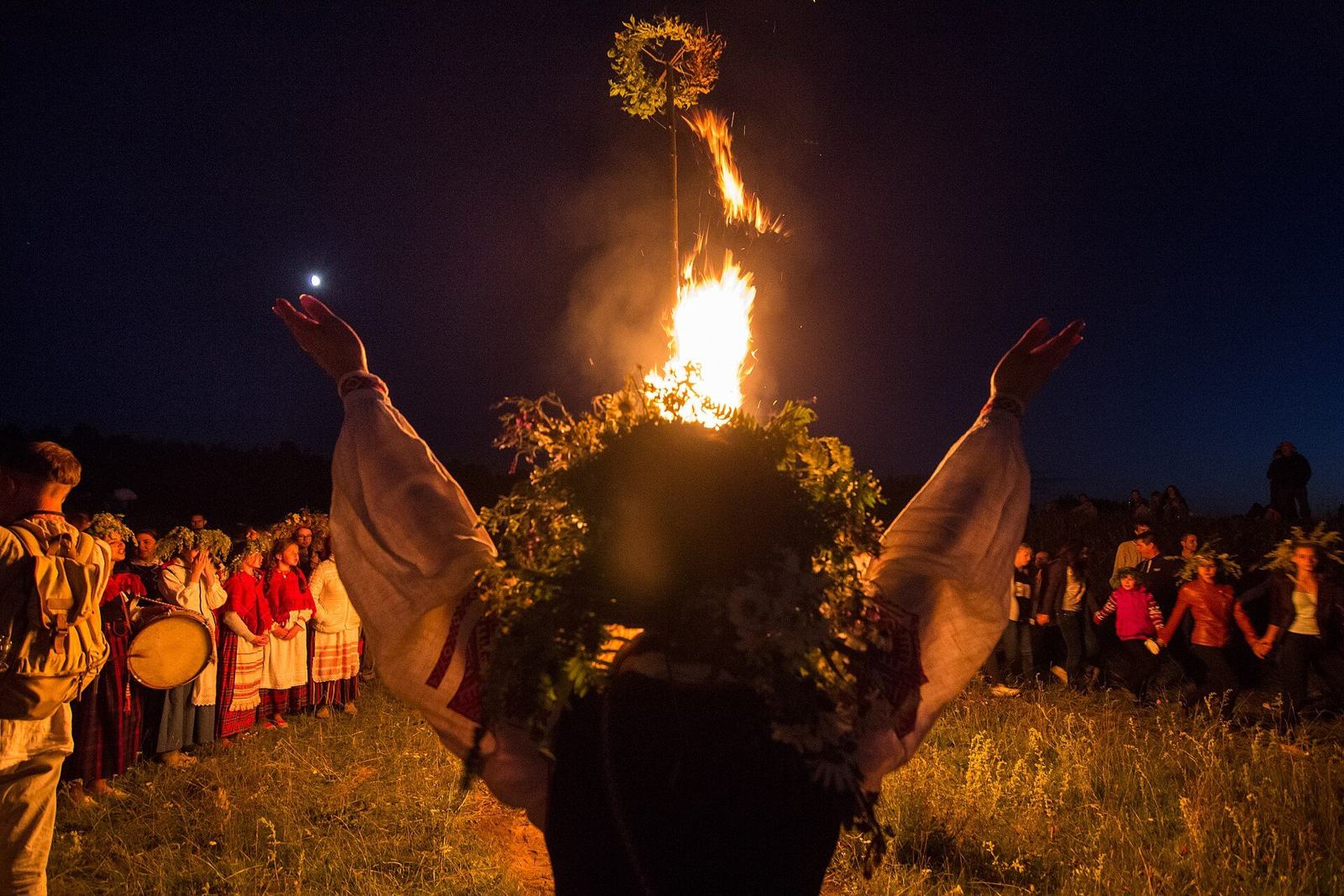
Today the Dnieper is the stage of Belarus's largest Kupalle festival. Since 2010 Alexandria Gathers Friends has been held each July in the agro-town of Alexandria in the Shklov district, combining the folk rites of Kupala Night — bonfires, wreaths floated on the water, khorovods around the fire — with round dances, concerts and crafts for several tens of thousands of guests.
Mogilev also gave Belarus one of its leading stage ensembles. Khoroshki, which began professional concert work at the Belarusian State Philharmonic in January 1974, grew out of the Mogilev amateur ensemble Vyasnyanka; its founders, Valentina Gaevaya and Nikolai Dudchenko, led it to first prize at the all-Union competition of professional dance companies in 1977.
The south-east keeps Belarus's most famous living round dance. In Pahost, in the Zhytkavichy district, St George's Day (6 May) is marked by the Juraŭski Karahod: villagers in traditional dress carry the ritual bread called karahod, an embroidered towel and an eight-pointed star to the fields, women sing the songs that call the spring, and the dancers circle clockwise around the ritual symbols before a crust of black bread is buried for a good harvest. UNESCO inscribed the rite on its Urgent Safeguarding List in 2019.
South-eastern Belarus also keeps “leading the arrow” (Striala), a spring rite first described in the early 1920s and still practised there at the end of the 20th century: the women leave the village singing and bury the “arrow” — a doll, a green twig or ornaments — in a field to draw lightning away from the village. Folklorists note that in this region the old ritual songs have often outlived the processions and round dances they once accompanied.
Spring round-dance songs such as “Oj, nie rasci, kropie” were recorded in the Svetlahorsk district as well as in western Palesse. At harvest's end, Dazhynki festivities across the regions bring out paired village dances such as Lyavonikha and Kryzhachok, played on accordion, violin, dulcimer, tambourine and pipe.