··EN · ES · FA
Tap a region to read its story
Swipe the timeline
Belarusian dance belongs to places: to the Radziwiłł castle where a princess founded a ballet school, to the Grodno estates where serf children became the king's dancers, to the Minsk stage of the Bolshoi, to Vitebsk's open-air amphitheatre, and to the village greens where Kupalle round dances still turn. These eleven places tell that story — and most of them are within a day's journey of Minsk.
The capital is the home of Belarusian stage dance. The opera and ballet theatre opened on 25 May 1933 with Carmen, and its constructivist building by Iosif Langbard rose on Trinity Hill, on the site of an old market, opening on 10 March 1939; Langbard also designed the park around it. Damaged in the war and restored by 1948, it was renovated and reopened in 2009, and on its stage Belarusian ballet was born with Nightingale in 1939. The State Philharmonic is the base of the Khoroshki ensemble, founded there in 1974. On Kupalle night the city celebrates too: in the Botanical Garden more than a thousand people have joined round dances with musicians, stilt walkers and fire performers.
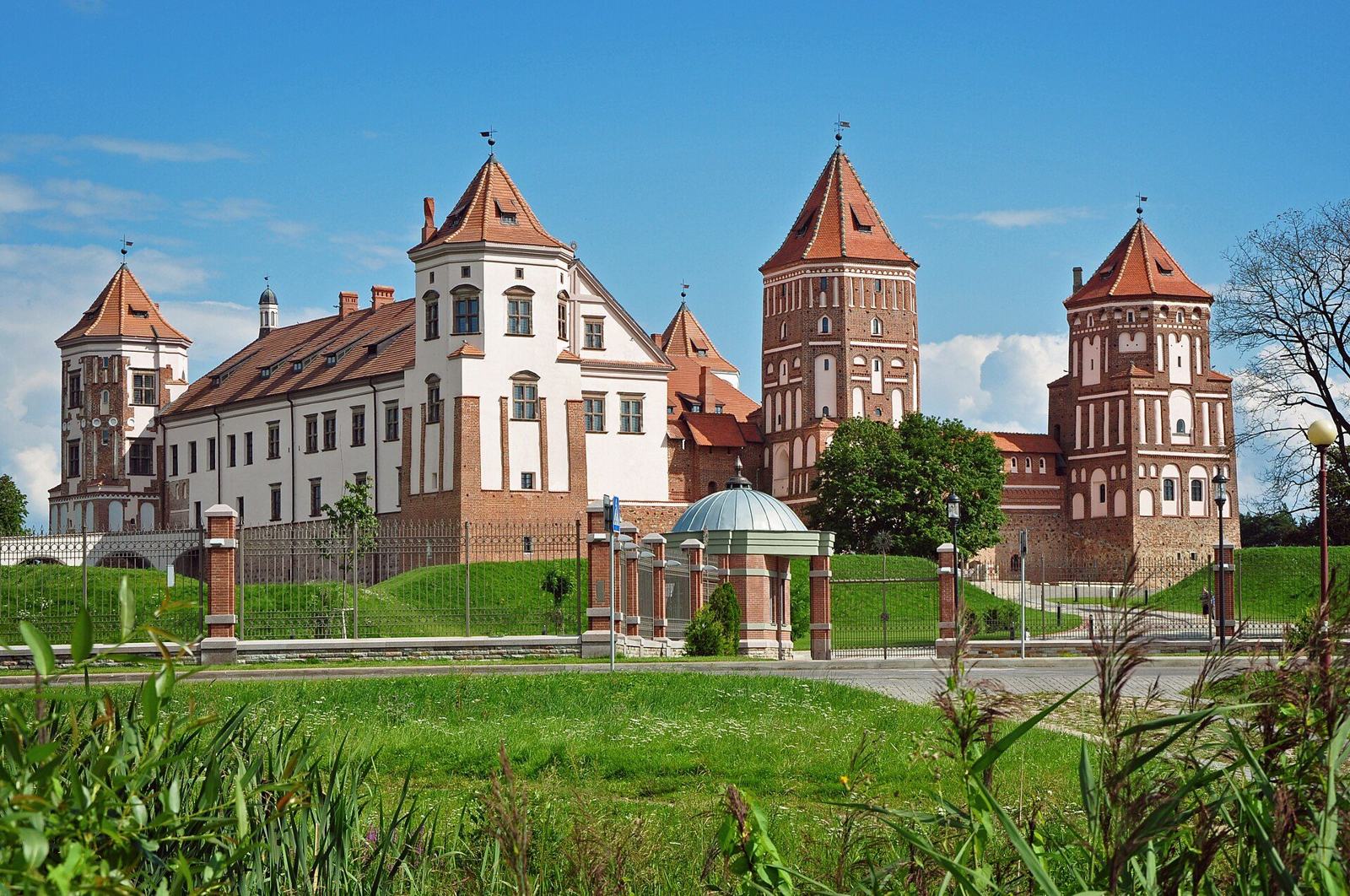
In the Grodno region stands Mir Castle, begun at the end of the 15th century in the Gothic style and later rebuilt with Renaissance and Baroque features. Heavily damaged during the Napoleonic Wars, it was restored at the end of the 19th century, and in 2000 the Mir Castle Complex became one of the first Belarusian sites on the UNESCO World Heritage List. With nearby Nesvizh, it is the classic setting for imagining the noble world of the polonaise and the mazurka.
Nesvizh was the seat of the Radziwiłłs from the 16th century until 1939: a castle of 1583 with ten connected buildings around a six-sided courtyard, linked by a dam to the Corpus Christi church, the family mausoleum — a UNESCO World Heritage Site since 2005. In the 1740s Princess Franciszka Urszula Radziwiłłowa wrote and staged plays here and founded a theatre with a choir and a ballet school. The tradition continues: the Bolshoi Theatre of Belarus holds evenings of opera and ballet at the Radziwiłł castle.
On the Polish border, Brest is known first for its fortress, whose garrison held out for over a month after the attack of 22 June 1941; the memorial complex opened on 25 September 1971. Every September the city also becomes a stage for the international theatre festival Belaya Vezha, whose programme spills onto the streets — in one edition it closed with a wordless show of gesture, dance and acrobatics by a Prague company in Lenin Square.
Shared with Poland, the Białowieża (Belavezha) Forest has been a World Heritage Site since 1992. In the Belarusian national park, Father Frost's estate is the stage of a lively Maslenitsa: more than 1,500 people have gathered there for concerts, crafts and pancakes, and for the “12 months” scene in which the winter god Zyuzya hands his powers to the spring goddess Lyalya and a winter effigy is burned.
In the far north of Paazerje, near the borders of Latvia and Lithuania, Braslav is a district of lakes and villages with a busy folk life. Its groups include the exemplary choreographic company Takt of the district culture centre, the Ulybka dance group of Vidzy — dancers aged 3 to 20 who perform folk and stage dances —, the folk song and music ensemble Na Panadvorku, active for more than twenty years, and the Vidzauchanka folk song ensemble founded in 1996. They perform at local and international events such as the festival Braslav Zarnitsy.
Vitebsk is the festival city of Belarus. Its open-air Summer Amphitheatre, built in 1988, is the main stage of the Slavianski Bazaar, which opened on 18 July 1992 and brings singers and ensembles of the Slavic peoples to the city every July, along with the award “Through Art — to Peace and Understanding”. Since 1987 Vitebsk has also hosted the International Festival of Modern Choreography, a competition of ballet, modern, jazz and hip hop dance whose jury has been chaired by the ballet star Vladimir Vasiliev.
First mentioned in a chronicle in 862, Polotsk was the capital of the principality that dominated the Belarusian lands between the 10th and 12th centuries. Its St Sophia Cathedral was built in 1044–1066, destroyed in 1710 and rebuilt in the Vilnius Baroque style in 1738–1750; today it is a museum whose organ hall hosts music festivals every year. The city is also the birthplace of Francysk Skaryna, the first Belarusian printer, and home to the convent of St Euphrosyne of Polotsk.
In the 18th century Grodno was the main residence of Antoni Tyzenhauz, who founded a theatre, a ballet, an orchestra and schools there; 30 dancers trained on his estates became the Polish king's National Dancers in 1785. Today the city celebrates the dances of all Belarus's communities at the Republican Festival of National Cultures, held since 1996: 43 nationalities took part in 2026, when the finale filled Grodno on 5–6 June with farmsteads presenting songs, dances, rituals and food.
Just outside Minsk, the Belarusian State Museum of Folk Architecture and Rural Lifestyle was founded in 1976 near the village of Azyartso; its exposition zones opened between 1987 and 1994, with houses, churches and farm buildings grouped into the regions of Central Belarus, Padniaprouje and Paazerje. It is the best place to meet the folk calendar: Kaliady with carols and round dances, Hukanne viasny with spring songs, Kupalle with singing, round dances, wreath weaving and the search for the fern flower, and the autumn Pakrowski kirmash with dancing and games. On Kupalle night visitors jump over the bonfire and girls float wreaths on the water.
In the Smarhon district of Grodno region, Michał Kleofas Ogiński built a classicist palace in 1802–1822 after returning from exile, and for some twenty years Zalesse was a “Northern Athens” of art exhibitions, balls, literary readings and musical evenings. Some historians believe that his polonaise Farewell to the Homeland was written and first performed here, although the attribution itself is now debated; Ogiński is credited with adding the contrasting trio to the polonaise form. After large-scale restoration, the palace reopened as a museum and cultural centre on 26 September 2014.