··EN · ES · FA
Tap a region to read its story
Swipe the timeline
In Belarus the oldest dance is a circle. For centuries villagers between the Neman and the Dnieper sang and moved hand in hand around a bonfire, a birch tree or a loaf of ritual bread, marking the turning of the farming year. Above them, in the castles of the great noble families, polonaises opened the balls and serf children were trained as ballet dancers. In the 20th century both worlds met on stage — in the Bolshoi Theatre in Minsk and in folk ensembles that toured the world. This is that story, told with its sources.
Traditional Belarusian village life followed a calendar of festivals, and many of them were danced. The open-air folk museum near Minsk still keeps the cycle: Kalyady at midwinter, with carols and round dances; Maslenitsa, the farewell to winter; Hukanne viasny, “calling the spring”, with special spring songs; Kamayedzitsa, a spring feast dedicated to the bear; Yurya, the first day the herds go out to pasture; Kupalle in midsummer; Zazhynki and Dazhynki, the beginning and end of the harvest; and the autumn fair of Pakrowski kirmash, with dancing and games. Folklorists note that in many villages the songs of these rites outlived the games and dances that once went with them.
Kupalle is the high point of summer. Because Belarus follows the Julian calendar for the feast, it falls on the night of 6–7 July. Villagers carried old things to a glade or a high riverbank and burned them on a bonfire built around a pole topped with a wheel; young people sang and danced round it in khorovods, and a boy and a girl jumped over the flames holding hands — if their hands stayed together, it was read as a sign of marriage. Girls floated wreaths of herbs and flowers on the water to tell their fortunes, and everyone hoped to find the legendary flower of the fern.
Dazhynki closes the harvest. Its “main star” is the last sheaf of grain cut in the field, carried in procession with huge festive loaves baked from the new flour. Then come the dances, performed in pairs: Lyavonikha, Kryzhachok, the polka and others, played by village musicians on the accordion, violin, dulcimer, tambourine and pipe.
Karahod is the Belarusian name of the khorovod, the Slavic dance that joins a circle of dancers with choral singing; the dancers hold hands, or just little fingers, as they move. Belarusian dance scholars count round dances among the oldest forms, possibly going back to the end of the first millennium, and divide them into song round dances with simple figures — circles, lines and snakes —, playful round dances with jumps and whirling, and round dances in which movement leads and the song accompanies. Ornamental dances such as Kryzhachok and Kola draw geometric figures on the ground.
Round dances belonged above all to spring and early summer. On St George's Day young people once walked through the sown fields singing songs that called for a good harvest, and in Trinity week girls danced around a birch tree in the forest. Even the Myatselitsa — “snowstorm” — keeps the character of the khorovod: its quick spinning figures imitate a blizzard, and it was originally danced to choral singing alone; only in the late 19th and early 20th centuries did a violin or a small band join the singers.
One spring round dance still lives in its home village. In Pahost, in the Zhytkavichy district of Gomel region, people celebrate St George's Day (6 May) with the Juraŭski Karahod. On the eve they bake the ritual bread — itself called karahod — and a dark loaf; in the morning they go out to the fields with an embroidered towel, the bread and an eight-pointed star. Women sing the old songs that call the spring while the men carrying the karahod form a circle, and the dancers move clockwise around the ritual symbols; a piece of the black loaf is buried in the earth as a prayer for the harvest. In 2019 UNESCO inscribed the rite on its List of Intangible Cultural Heritage in Need of Urgent Safeguarding.
Kalyady runs from late December into January, joining Christmas and Epiphany with much older winter customs. Groups of carollers go from house to house, moving from east to west like the sun, and every visit has three parts: greeting the household, performing songs and games, and receiving treats. They come in costume — Kaza the goat, a symbol of fertility and energy, Kon the horse, Dzied and Baba, the old man and the old woman — with the harmonika keeping everyone warm and dancing.
In the village of Semezhava, in the Kapyl district of Minsk region, Kalyady takes a unique form. Each year seven young men are chosen to play the Kalyady Tsars in a folk version of the historical-religious drama Tsar Maximilian. In bright costumes they visit the houses of the village — especially those of unmarried girls — perform comic scenes and receive good wishes and gifts, while the comic figures of dzad and baba tease the audience; the procession goes on late into the night by torchlight. UNESCO placed the rite on its Urgent Safeguarding List in 2009, the first Belarusian element on its lists.
Winter was also the season of the batleika, a folk puppet theatre named after Bethlehem, whose oldest evidence dates from the end of the 16th century. It was played in a wooden box shaped like a church or a two-storey house: the upper, “heavenly” level showed the Nativity and the story of King Herod, the lower, “earthly” one comic scenes of peasants, traders and lords led by the cunning peasant Matsey. Rod puppets moved along slots in the floor to the sound of a violin and a tambourine. Almost forgotten in the 20th century, the batleika has been revived since the 1980s by theatres and puppeteers.
In the Grand Duchy of Lithuania, to which the Belarusian lands belonged, and in the Polish–Lithuanian Commonwealth it formed with the Kingdom of Poland, the gentry danced the polonaise. It grew from a 17th-century walking dance, the chodzony, rooted in folk wedding dances; before the end of the 16th century the gentry had already adopted these dances, and in the 18th century the French name polonaise replaced “the Polish dance”. Couples walk arm in arm around the hall in a stately triple metre, bowing at the cadences, while musicians play from the gallery — and to this day the polonaise opens formal balls.
The mazurka came from the Mazurs of east-central Poland around the 16th century: a dance in 3/4 or 3/8 with a forceful accent, danced with the head held high and the torso erect, often in the long kontusz coats of the nobility. It spread to the ballrooms of Russia and Germany and reached France and England by the 1830s; Chopin wrote about 57 mazurkas for the piano. In the salons of the 1830s and 1840s the polonaise and mazurka were heard as dances of the old Commonwealth.
The best-loved polonaise in Belarus is Farewell to the Homeland, in A minor, traditionally attributed to Michał Kleofas Ogiński and dated to about 1794 — though no autograph survives and recent research doubts both the date and the authorship. Ogiński is credited with adding a contrasting trio section to the polonaise. From 1802 he lived at his estate of Zalesse, near Smarhon, which became famous as the “Northern Athens” for its balls, readings and musical evenings.
Nesvizh was the seat of the Radziwiłłs, the most powerful magnate family of the Grand Duchy. Their castle was erected in 1583, and the dynasty built up and kept the ensemble until 1939: ten interconnected buildings around a six-sided courtyard, linked by a dam to the Corpus Christi church, the family mausoleum. In 2005 UNESCO inscribed the complex on the World Heritage List.
Theatre came to the castle in the 18th century. A foreign troupe staged a play there in 1740, and from 1746 Princess Franciszka Urszula Radziwiłłowa (1705–1753) wrote and directed her own works, beginning with the comedy Ingenious Love; she is remembered as the first woman playwright of the Belarusian lands. She founded the Nesvizh theatre together with a choir and a ballet school, and after her death her sixteen pieces — nine comedies, five tragedies and two operas — were published as Komedyje y tragedyje (1754), with engravings after her own drawings.
Her brother-in-law Hieronim Florian Radziwiłł made Slutsk another centre. Around 1753 a free-standing theatre was built in the middle of the town — a rarity in the Commonwealth of the 1750s. Its repertoire began with German commedia dell'arte and occasional operas, but in the second half of the decade one-act ballets came to dominate it; the artistic heyday ended with the prince's death in 1760. The National Library of Belarus lists ballet schools at Nesvizh, Slutsk and Slonim among the achievements of these magnate theatres.
Grand Hetman Michał Kazimierz Ogiński (1728–1800) turned Slonim into one of the great artistic courts of Europe, living there from 1764 to 1784. In the 1770s and 1780s he built a theatre for 2,000 spectators, with a large stage and machinery for opera seria, where performances were given almost daily by an Italian and a Polish opera company. A ballet ensemble belonged to the theatre, and a school trained dancers and musicians — in the late 1780s under the ballet master F. Szlancowski. In 1788 the Slonim dancers were placed at the king's disposal.
In Grodno, the royal administrator Antoni Tyzenhauz opened schools for midwives, doctors, accountants and engineers — and even for ballet dancers. On his estates at Grodno and Pastavy, 30 dancers chosen from among his serfs were trained by François Gabriel Le Doux from Paris and Daniel Curz from Venice. In 1785 they became His Majesty's National Dancers (1785–1794), the first professional ballet company of predominantly Polish dancers, performing at the National Theatre in Warsaw: one of the roots of Polish ballet grew in Grodno.
These were not isolated cases. From the 18th century to the first half of the 19th, private theatres flourished in towns and estates across the Belarusian lands — the Radziwiłłs in Nesvizh and Slutsk, Semyon Zorich in Shklov, Tyzenhauz in Grodno, the Sapiehas in Ruzhany and Ogiński in Slonim — and most of them kept their own ballet troupes.
In the 19th century scholars began to write down the village culture. Jan Czeczot published Village Songs from the Neman (1837) and from the Neman and the Dvina (1839 and 1846), and in 1837 Eustachy Tyszkiewicz made his debut with a description of the entertainments of country people and the feast of Kupala. Pavel Shein's Belarusian Folk Songs (1873–1874) gathered more than a thousand texts, about 400 recorded by Shein himself; his three-volume Materials for the Study of the Life and Language of the Population of the North-Western Territory (1887–1893) added 789 and 911 songs, wedding and funeral rites, tales and ethnographic notes. Michał Federowski's The Belarusian People in Lithuanian Rus', begun in 1897, ran to eight volumes.
The summary of the age was Yefim Karsky's Belarusians, published between 1903 and 1922: three volumes in seven books and 3,105 pages, covering the language, literature and folklore of the Belarusians from the 13th to the early 20th century. Its volume Folk Poetry (1916) analysed the content, genres and style of the songs that had accompanied village rites and dances.
Meanwhile the dances themselves were changing. From the middle of the 19th century village dancing merged with the quadrilles and polkas of Western Europe. Belarusian villages made the quadrille their own — local versions are known as Lusterka, Sher or Smorgonskaya, some for as many as 40 couples — and the polka produced local variants such as Trasukha and Yanka. At the end of the century, however, Belarusian dance was still little known outside the villages themselves.
On 9 February 1852 the Minsk City Theatre premiered Sielanka (Idyll), staged by the writer Vincent Dunin-Marcinkievič with the composers Stanisław Moniuszko and Konstantin Krizhanovsky. Arias, duets, choruses and dances were performed; Dunin-Marcinkievič himself played Nahum Pryhavorka, and the peasant chorus of his estate at Lyutsinka, near Rakaw, sang in the production. The authorities soon banned the piece for its “demotic” language, and it went on to be played privately in houses across Belarus. Art historians regard this staging as the starting point of Belarusian professional theatre.
Half a century later Ihnat Bujnicki (1861–1917), born on the Palivachy estate in the Hlybokaye district, founded in 1907 the troupe that performed in Belarusian towns and in Warsaw and St Petersburg. He was director, actor and dancer at once, and Belarusian folk dances were his special passion: his repertoire held more than a dozen of them, performed close to their village models alongside songs and poetry, to violins, cymbals and bagpipes. He is remembered as the father of the Belarusian theatre — and as the man who first carried Belarusian dance to city audiences.
The country's first permanent opera and ballet theatre opened in Minsk on 25 May 1933 with Bizet's Carmen. Its home was designed by the architect Iosif Langbard on Trinity Hill and opened on 10 March 1939; in 1940 the theatre received the title “Bolshoi”. The auditorium was destroyed by a bomb during the Second World War, the building was fully restored by 1948, and after a major renovation it reopened in 2009 with new sculptures, a modernised stage and up-to-date lighting.
The first Belarusian ballet, Nightingale (Salavei), with music by Mikhail Kroshner and choreography by Aleksey Yermolayev and Fyodor Lopukhov, was based on a story by the writer Źmitrok Biadula. It premiered in Minsk on 5 November 1939 and was shown in Moscow during the Decade of Belarusian Art in 1940; its style blended classical technique with elements of folk dance — the formula of Belarusian national ballet.
From 1973 the company was shaped by Valentin Elizariev, born in Baku in 1947, who became its chief ballet master at the age of 26. His productions — Carmen Suite (1974), The Creation of the World (1976), Spartacus (1980), Carmina Burana (1983), Boléro (1984), The Rite of Spring (1986) and many classics — earned him the title People's Artist of the USSR (1985) and the Benois de la Danse prize (1996); he led the ballet until 2009 and returned as artistic director of the whole theatre in 2018. The theatre's repertoire also includes national ballets such as Anastasia and Vitovt by Viachaslau Kuznetsov.
The most famous “Belarusian” stage dance has a surprising history. After visiting Belarus in the late 1930s, the Moscow choreographer Igor Moiseyev created Bulba — “potato” — on a Belarusian folk song of the same name, a humorous picture of potato farming. Belarusians adopted it as their own: Moiseyev later recalled being told that the dance had “always been around”, while folklorists noted that it appeared only after his choreography. Today Bulba is danced by folk ensembles throughout the country.
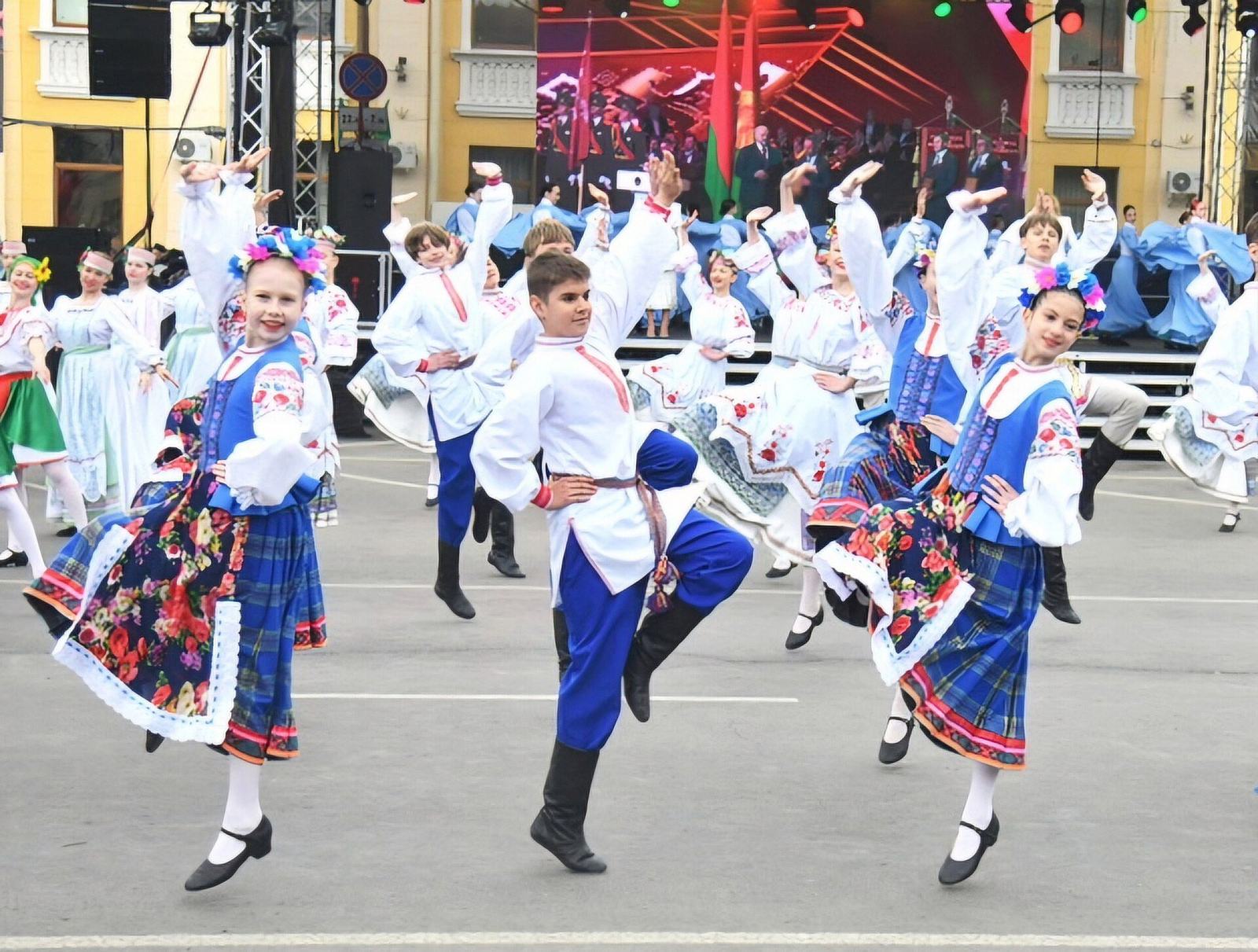
Around 1959–1960 the State Dance Ensemble of Belarus was created; at its fiftieth anniversary in 2010 it was described as blending folklore with the best of world choreography, with colourful costumes, virtuoso stunts and a bold performing style. Under its long-time artistic director Valentin Dudkevich, its programmes included Belarusian Casket, of traditional Belarusian dances, Round Dance of Friends, of dances of the world, and The Song about the Bison, episodes from Belarusian history — with dances such as Lyanok and the Belarusian polka.
In January 1974 a new ensemble began work at the Belarusian State Philharmonic in Minsk, built on the Mogilev amateur group Vyasnyanka: Khoroshki, led by the choreographers Valentina Gaevaya and Nikolai Dudchenko. It toured Denmark in 1975, won first prize at the all-Union competition of professional dance companies in 1977 and became an independent company in 1981. With about 60 dancers and its own orchestra, Khoroshki built programmes such as Seasons of the Year, Polotsk Manuscript and Turov Legend, toured Europe, the Middle East, India, Japan and China, and appeared at the opening of the 2002 Winter Olympics in Salt Lake City.
Vitebsk became the country's dance festival city. The International Festival of Modern Choreography began there in 1987, while Belarus was still part of the Soviet Union, and grew into a showcase of ballet, modern, jazz and hip hop dance. Its prize-winners included choreographers who went on to international careers, such as Tatiana Baganova, Olga Pona and Sasha Pepelyaev, and the ballet star Vladimir Vasiliev has presided over its jury.
In the same city, the Slavianski Bazaar opened on 18 July 1992, growing out of a Polish song festival held in Vitebsk in 1988 and 1990. Its main stage is the open-air Summer Amphitheatre, built in 1988. Centred on the music of the Slavic peoples — from Belarus, Russia, Ukraine, Poland, Bulgaria and the former Yugoslavia — it brings folk and stage ensembles, singing competitions and an award “Through Art — to Peace and Understanding” to Vitebsk every July.
Since 2010 Kupalle has had its own great festival: Alexandria Gathers Friends, held in the agro-town of Alexandria in the Shklov district, on the banks of the Dnieper. Its programme combines the folk rites of Kupala Night with round dances, concerts and crafts, and it draws several tens of thousands of guests each July.
Belarus now has seven elements on UNESCO's intangible heritage lists: the Rite of the Kalyady Tsars (2009) and the Spring rite of Juraŭski Karahod (2019), both on the Urgent Safeguarding List; the Budslaŭ fest (2018); tree beekeeping culture (2020, shared with Poland); straw weaving (2022); vytsinanka paper cutting (2024); and the Negliubka textile tradition of the Vetka district (2025). Two of them — the Kalyady Tsars and the Juraŭski Karahod — are performed with dance, music and song, and both were inscribed because their village bearers are growing old.
Many people meet the old calendar today in open-air settings. The Belarusian State Museum of Folk Architecture and Rural Lifestyle, founded in 1976 near the village of Azyartso outside Minsk, celebrates Kaliady with carols and round dances and Kupalle with singing, round dances, wreath weaving and the search for the fern flower. On Kupalle night in Minsk's Botanical Garden more than a thousand people have joined round dances with musicians, stilt walkers and fire performers.
Belarus also dances the traditions of its many communities. Since May 1996 the Republican Festival of National Cultures has gathered them in Grodno: eleven nationalities took part in the first edition, and 43 in 2026, when the final celebrations were held in Grodno on 5–6 June, with traditional farmsteads presenting their songs, dances, rituals and food.