··EN · ES · FA
Tap a region to read its story
Swipe the timeline
Austria is a federal republic of nine states, and each has its own way of dancing. In Vienna, couples turn to the waltz from November to Shrove Tuesday; in the farming country north of the Alps, young men's fellowships dance their own Landler and sing mocking verses; in the mountains, masked dancers stamp and leap to drive out winter; and in the east, Croatian and Hungarian villages keep their own music. Use the map to choose a state, or travel from Vienna in the east to Vorarlberg on Lake Constance.
Vienna is the capital of the waltz. Its ball season runs from 11 November to Shrove Tuesday, and in 2023/24 the Austrian Economic Chamber expected about 540,000 guests at more than 450 balls — from the Opera Ball to the balls of lawyers, doctors, coffee-house owners and schools. Every one opens with the call “Alles Walzer!”, and the Viennese waltz, played, danced and sung, has been on Austria's national inventory of intangible heritage since 2017; the same inventory notes that the bride's waltz belongs to weddings in many regions.
Vienna is also a city of folk dancers. Its folk-dance groups formed a working association in 1949 that runs the Wiener Kathreintanz, held since 2011 at the Palais Ferstel, which regularly draws more than a thousand dancers in Tracht just before Advent. In July and August there are open-air folk-dance evenings twice a week, and an autumn dance is held at the Belvedere palace.
And Vienna is a stage for contemporary dance: every summer since 1984 ImPulsTanz has filled the city with workshops and performances, and since 2001 it has opened in the courtyard of the MuseumsQuartier.
The state that surrounds Vienna is where Austria's folk-dance research began in earnest. The Viennese teacher Raimund Zoder founded the Lower Austrian Folk Song Archive, recording songs, tunes and dance figures that had never been written down, and from 1920 he gave courses for the folk-song committee of Vienna and Lower Austria. Today folk-dance groups are active in every part of the state, as in all nine federal states.
In the Mostviertel, groups of young men called Ruden still dance the Landler in local variants: every Shrove Tuesday the Rudentanz in neighbouring Sierning invites ten to twelve groups from the Traunviertel and the Mostviertel to dance and sing new mocking verses. Couples at village fairs also dance polkas and the Zwiefacher, a round dance that switches between three-beat and two-beat bars.
Spring brings the Bandltanz, the maypole dance of 1 May, in which men and women weave red and white ribbons around a decorated Maibaum. And at Laxenburg, just south of Vienna, the Hellerau-Laxenburg school — which moved here in 1925 — trained a generation of modern dancers under Rosalia Chladek until 1938.
In the Innviertel, the Landler belongs to the Zechen, the old rural fellowships of young men. Around 1850 each fellowship built its own Landler from common figures in a fixed order, so the variants can all be danced to the same music; the dance, called the Eicht, combines movement, music, poetry and song, and the melody ends with a special yodel, the Almer. Its distorted 3/4 rhythm sets it apart from other Ländler. Many Zechen declined from the 1950s, but 25–30 groups still dance it, and it entered the national heritage inventory in 2013.
In Sierning, in the Traunviertel, the Ruden have met every Shrove Tuesday for at least 200 years. Groups of rural young men dance the Traunviertler Landler and sing harmonised verses written new each year, mocking local, national and world events as a “moral corrective”; the Rudentanz was added to the national inventory in 2013.
In the Salzkammergut, the night of 5 January belongs to the Glöckler: runners in white with huge illuminated caps — shaped like stars, pyramids or churches — and heavy bells on their backs run through Ebensee, Gmunden, Traunkirchen, Bad Ischl and other towns to drive away the dark spirits of the Rauhnächte. The Ebensee Glöcklerlauf has been on the national inventory since 2010, in a region whose Hallstatt-Dachstein cultural landscape has been a World Heritage Site since 1997.
Salt made Salzburg rich, and the salt miners had their own dance. The sword dance of the Dürrnberg above Hallein, rooted in the medieval guild dances of craftsmen, has been performed for about 500 years. Until the salt works closed in 1989 it was danced every four years, led by the works manager and the mine director; today a society of former miners keeps it alive for special occasions, and it has been on the national inventory since 2011.
In the Pinzgau, on 5 and 6 January, the Tresterer appear: men of all ages in tall costumes who, as “beautiful Perchten”, bring good harvests, luck and health to the farms. A leading dancer, the Vorpercht, stamps the signal, and the group performs a complex round dance of hopping and stamping steps, with or without music. The Pinzgau Tresterer dance was recognised as intangible cultural heritage in 2013.
Salzburg shares with Tyrol and Upper Bavaria the cradle of the Schuhplattler, and the world knows its Ländler from the screen: in The Sound of Music, Maria and Captain von Trapp dance a Ländler whose choreographers researched traditional Austrian folk dance. The city is also a centre of dance scholarship — since 1975 the University of Salzburg has kept the Derra de Moroda Dance Archives.
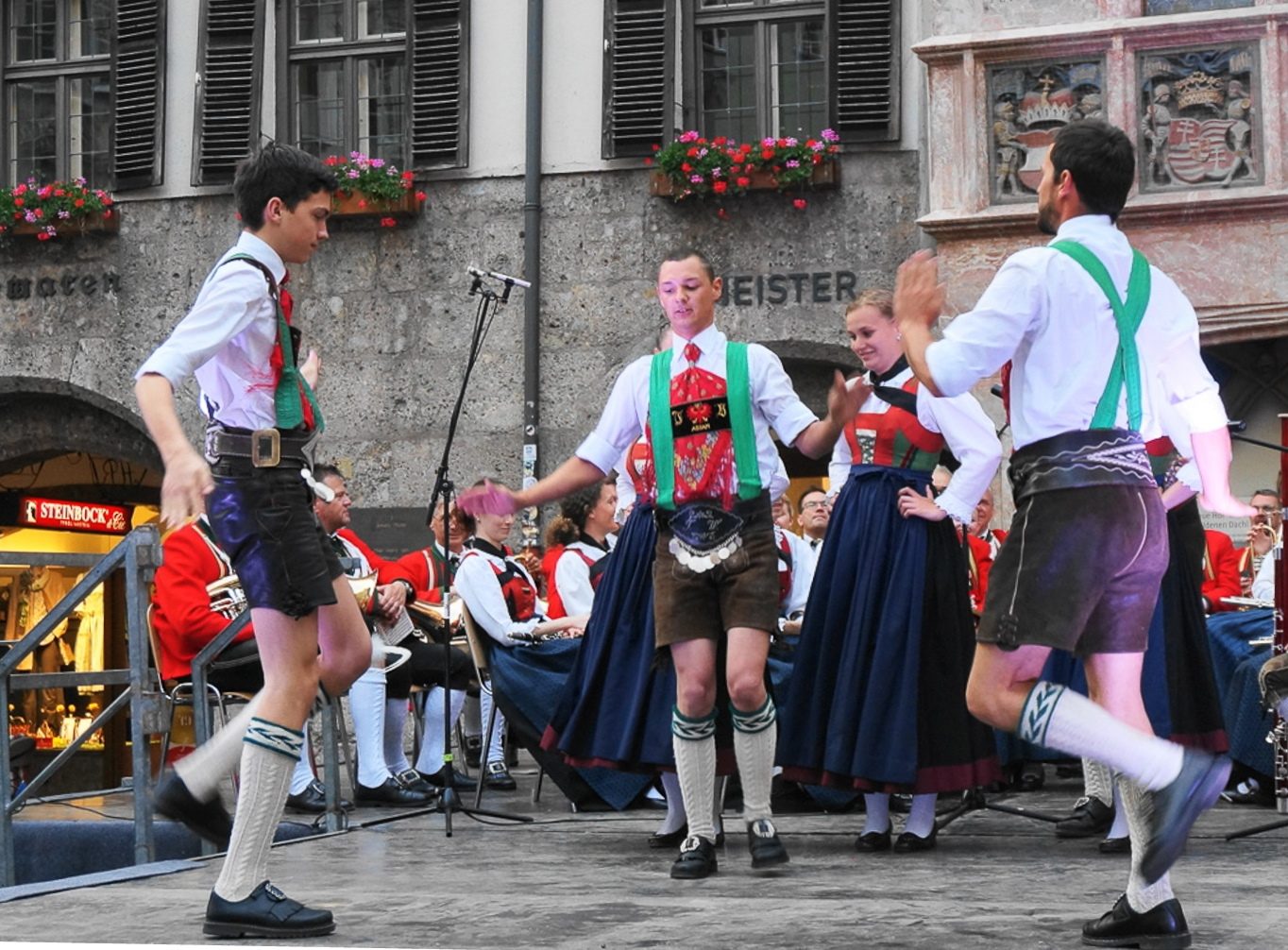
The Schuhplattler grew up in the eastern Alps — Upper Bavaria, Tyrol and Salzburg. Dancers stamp, clap and strike their soles, thighs and knees with flat hands; there are more than 150 basic Platteln, usually in 3/4 time like the Ländler. In the couple form the pair dances a Ländler and then separates, the woman twirling while the man shows off his steps; in the “boys' dance” the men perform in a circle or line. In the late 19th century Trachtenvereine, traditional-costume clubs, were founded across Bavaria and Tyrol and made the Schuhplattler the heart of their programmes.
Tyrol is home to Austria's dance custom on UNESCO's international list. About every four years, on the Sunday before Lent, the town of Imst celebrates the Schemenlaufen: fifty-five pairs of masked main figures perform a special dance of jumps and bows, one dancer with rotating bells, the other with larger bells weighing up to 35 kilograms, forged by local smiths; around them witches shout, chimney sweeps climb houses and bears show their strength. The Schemenlaufen was inscribed on the Representative List in 2012.
For visitors, the easiest way to see Tyrolean dancing is a Tyrolean evening: in Innsbruck the Gundolf family has presented folk music, Tyrolean dances, yodelling and the Schuhplattler since 1967.
Austria's westernmost state marks the end of carnival with fire. On the Saturday and Sunday after Ash Wednesday, villages build tall wooden towers, the Funken, and set them alight; a straw witch filled with powder traditionally crowned the top, though many bonfire clubs have dropped it in recent years, and people eat Funkaküachle, a yeast-dough treat. Vorarlberg's Funkensonntag was selected for the national inventory in 2010, and the disc flinging (Scheibenschlagen) of places like Gortipohl in the Montafon, where some 500 glowing discs are hurled into the night, was added in 2016.
Vorarlberg's folk dancers belong to the same national movement as the rest of Austria: the Federal Association of Austrian Folk Dance brings together associations from all nine states, and its groups share a common repertoire of Ländler, polkas and round dances, from the Boarischer to the Kreuzpolka, at dance festivals and seminars.
Styria gave its name to a whole branch of the Ländler family: the Steirischer, danced with improvised satirical verses and syncopated hand-clapping. Its instrument is the Steirische Harmonika, the diatonic button accordion heard in folk-dance halls all over Austria, and the reference collection used by dance groups across the country is still Volkstanzmappe A: Steirische und gesamtösterreichische Tänze — “Styrian and pan-Austrian dances”, re-edited in 2007.
Each September Graz hosts Aufsteirern, founded in 2002 and described as Austria's largest folk-culture festival: on the first weekend after the start of the school year more than 130,000 visitors fill the old town for three days of folk music, folk dance and Tracht. In 2010, 2,500 performers — choirs, brass bands, dance and music groups — played on eleven stages.
In the Lower Gail Valley, on the border with Italy and Slovenia, the church fairs are bilingual: in German the Untergailtaler Kirchtag, in Slovene the Ziljski žegen. Between May and October each village celebrates on its patron saint's day. After a festive mass come the Kufenstechen (štehvanje), in which young men riding bareback on Noriker horses try to shatter a small barrel on a pole with iron clubs, and then the Lindentanz — the prvi rej, or “first dance” — under the village linden tree, with slow and brisk dances in the region's traditional dress.
Written records of the fair go back to the 18th century and it has changed little since; the winner of the Kufenstechen receives a floral wreath, and the next day brings a mass, a requiem and the blessing of graves. Together with the traditional costume of the valley, the custom has been on the national inventory since 2018.
Austria's youngest and easternmost state joined the country only in 1921, carved from the western edge of Hungary, and it is the most multilingual. Its Croatian villages go back to the 16th century: from the 1530s, fleeing the Ottoman wars, Croats settled here on land granted by Ferdinand I, with further waves in the 1540s and the 1750s–60s. Their minority rights were guaranteed by the State Treaty of 1955.
Music is at the heart of Burgenland Croatian identity. Tamburica — the family of South Slavic plucked lutes and the ensembles that play them — is heard in many villages, with around forty orchestras active; groups such as Tamburica Cindrof of Siegendorf have played for some sixty years. The folklore ensemble Kolo Slavuj performs Burgenland Croatian dances in choreographies developed with the Croatian ethnochoreologist Ivan Ivančan.
Hungarian is spoken too, above all in the Upper Wart around Oberwart (Felsőőr), Unterwart (Alsóőr) and Siget in der Wart (Őrisziget), and the Roma of Burgenland — thousands of whom were deported under Nazi rule — are a recognised part of the state's history; together with the Croats they make Burgenland a meeting place of Central European music and dance.