··EN · ES · FA
Tap a region to read its story
Swipe the timeline
Austria's dances belong to places: the waltz to the ballrooms of Vienna, the Ländler to the Alpine valleys, the bell-dancers to the villages of Tyrol and Salzburg. Here are twelve famous places where every visitor — and every dance lover — can see, hear and join Austrian dance, from the gilded halls of the capital to the salt towns and mountain villages.
Vienna is where the waltz grew up. Johann Strauss II wrote The Blue Danube in his flat at Praterstrasse 54, and today the city's ball season — from 11 November to Shrove Tuesday — offers more than 450 balls, with about 540,000 guests expected in 2023/24. Folk dancers have their own big night in November, the Kathreintanz, held since 2011 at the Palais Ferstel, and in July and August open-air folk-dance evenings take place twice a week.
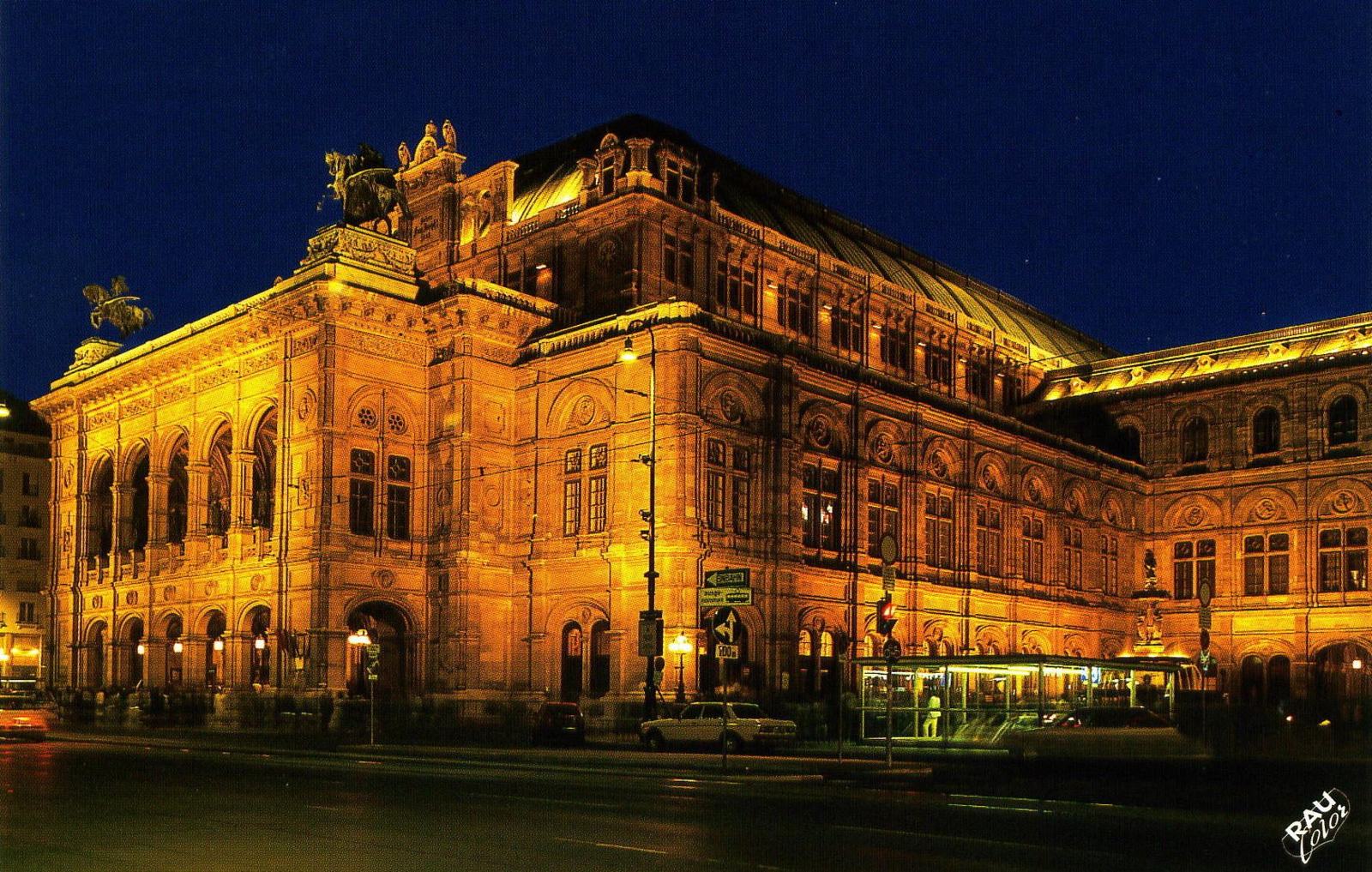
The Court Opera on the Ring opened on 25 May 1869 with Don Giovanni; destroyed by bombs in 1945, it reopened on 5 November 1955. It is the home of the Vienna State Ballet, formed in 2005, which still dances Die Puppenfee, created here in 1888 and performed more than 750 times. Once a year the auditorium becomes a ballroom for the Vienna Opera Ball, held since 1935 and revived in 1956: in 2025 about 5,150 guests attended and 144 debutante couples opened the dancing.
The emperors' palace has been a ballroom for almost three centuries. In 1748 its old theatres became the Redoutensäle, where masked balls were held each carnival; in 1772 Joseph II opened them to all ranks, and during the Congress of Vienna Joseph Lanner — later their music director — and Johann Strauss I led the orchestras. Today the Hofburg hosts many of the season's grand balls and, since 1969, a New Year's Eve ball, while in the palace's Winter Riding School the Lipizzaners of the Spanish Riding School perform the classical horsemanship UNESCO inscribed in 2015.
Theophil Hansen's Musikverein was inaugurated on 6 January 1870, and its Golden Hall — 1,744 seats and room for about 300 standing — is the home of the Vienna Philharmonic's New Year's Concert. First given on 31 December 1939, the concert of Strauss waltzes, polkas and marches now reaches audiences in more than ninety countries; it always ends with The Blue Danube and the Radetzky March, while dancers of the Vienna State Ballet waltz through Schönbrunn and the Opera in its filmed interludes.
Vienna's Stadtpark, opened on 21 August 1862, was the city's first public park, and its Kursalon, opened on 8 May 1867, soon became a favourite place for concerts and dancing: Johann Strauss II gave his first concert there on 15 October 1868. A few steps away stands the gilded bronze statue of Strauss with his violin, unveiled on 26 June 1921; its gilding was removed in 1935 and restored in 1991, and it is one of the most photographed monuments in Vienna.
Vienna's contemporary dance has its home in the former imperial stables. The Tanzquartier Wien, founded in 2001 at Museumsplatz 1, is a year-round centre for contemporary dance and performance with stages, training, theory and research. Every summer since 2001, ImPulsTanz — the festival founded in 1984 by Karl Regensburger and Ismael Ivo — has opened in the MuseumsQuartier courtyard, and it now offers more than fifty productions and over two hundred workshops and research projects.
Begun in 1696 for Emperor Leopold I and shaped by Maria Theresa, whose summer residence it was, Schönbrunn has 1,441 rooms and hosted ceremonial balls and banquets, including during the Congress of Vienna; it has been a World Heritage Site since 1996. Since 2004 the Vienna Philharmonic has given a free open-air Summer Night Concert in front of the palace for crowds of over 100,000, and the palace's halls and gardens are a favourite setting for the ballet films of the New Year's Concert.
The Salzburg Festival opened on 22 August 1920 with Max Reinhardt's staging of Jedermann on the steps of the cathedral, and in 1926 the Felsenreitschule, an episcopal riding school cut into the Mönchsberg rock, became one of its stages. Film fans know Salzburg from The Sound of Music, in which Maria and Captain von Trapp dance a Ländler based on traditional Austrian folk dance. The city also keeps the Derra de Moroda Dance Archives at its university, and just south, above Hallein, the Dürrnberg miners have danced their sword dance for about 500 years.
The Salzkammergut — the “salt domain” — has mined salt since the second millennium BC, and its Hallstatt-Dachstein cultural landscape has been a UNESCO World Heritage Site since 1997. Emperor Franz Joseph spent his summers at the Kaiservilla in Bad Ischl. The region's great dance-and-light custom is the Glöcklerlauf on 5 January: runners in white with handmade illuminated caps and heavy bells run through Ebensee, Gmunden, Traunkirchen, Bad Ischl, Bad Goisern and Obertraun to bring light and blessings; the Ebensee Glöcklerlauf has been on the national inventory since 2010.
The capital of Tyrol is the easiest place to see the dances of the Alps. Since 1967 the Gundolf family has presented a Tyrolean evening of folk music, Tyrolean dances, yodelling and Schuhplattler — the stamping, slapping dance of the eastern Alps — daily from May to October and twice a week in winter. Between 1995 and 2017 the city also hosted the Innsbruck Dance Summer festival, which brought international companies to Tyrol.
Styria's capital hosts Aufsteirern, founded in 2002 and Austria's largest folk-culture festival: on the first weekend after the start of the school year more than 130,000 visitors fill the inner city for three days of folk music, folk dance and Tracht, with a costume show on the Hauptplatz, and since 2015 the Graz Philharmonic has joined classical to folk music. In 2010, 2,500 performers appeared on eleven stages.
The mountain villages keep the oldest-looking dances in Austria. In Imst, about every four years on the Sunday before Lent, fifty-five pairs of masked dancers perform the jumps and bows of the Schemenlaufen, on UNESCO's Representative List since 2012. In the Pinzgau, on 5 and 6 January, the Tresterer stamp out their round dance to bring luck to the farms. And in Carinthia's Lower Gail Valley, between May and October, bilingual German-Slovene church fairs end with the Kufenstechen on horseback and the Linden dance under the village tree.