··EN · ES · FA
Tap a region to read its story
Swipe the timeline
Few countries are so closely identified with a single dance as Austria is with the waltz. But the waltz did not appear from nowhere: it grew out of the turning couple dances of Alpine villages, was polished in the ballrooms of Vienna and was carried around the world by Joseph Lanner and the Strauss family. Around it lies a much longer story — of minstrels and peasant round dances, of an imperial court that staged ballets on horseback, of ballet masters who taught dancers to tell stories without words, of women who reinvented dance in Vienna around 1900 and were driven into exile after 1938, and of the villagers, collectors and festivals that keep the Ländler, the Schuhplattler and the sword dances alive today.
The oldest surviving secular wall paintings in Vienna are about dancing and feasting. Around 1398–1400 the wealthy cloth merchant Michel Menschein had the banqueting hall of his house at Tuchlauben 19 decorated with scenes from the songs of Neidhart (c. 1180–1240), the minnesinger who mocked the peasants of the Danube villages. The cycle follows the seasons and shows a spring festival and a round dance, banquets, pranks and quarrels between knights and villagers; hidden under later plaster, it was rediscovered only in 1979.
In the villages, couples were already turning. Britannica traces the figures and triple rhythm of the Ländler — the Alpine dance that would one day become the waltz — to the turning dances typical of German-speaking peasant dances of the Middle Ages. Other dances kept their medieval irregularity: the Zwiefacher, which switches between bars of three and two beats, is older than the modern bar line itself, although the word “Zwiefach” is first documented only in 1780.
The stamping and slapping of the Schuhplattler may have equally deep roots: one of the earliest descriptions of an Alpine village dance with leaps and hand gestures is attributed to a monk of Tegernsee Abbey, just across today's Bavarian border, around 1030.
Ballet came to Vienna with the court. It began with the ladies-in-waiting of Empress Eleonora, wife of Ferdinand II, and the chronicle of the Vienna State Opera ballet dates the first ballet performance in the city to 1622. Under Leopold I court ballet had its first flowering, with music by composers such as Johann Heinrich Schmelzer, and in 1719 Maria Anna Scio became the first professional dancer of the court ensemble.
The most spectacular court dance of all was performed by horses. On 24 and 31 January 1667, to celebrate Leopold I's marriage to the Spanish infanta Margarita Teresa, the inner courtyard of the Hofburg was ringed with seats for La contesa dell'aria e dell'acqua (“The Contest of Air and Water”): about 1,000 costumed performers and 200 musicians, with Schmelzer's music and the emperor himself riding at the centre of the figures. The horses did not dance in the ordinary sense — they performed demanding high-school dressage — and the International Encyclopedia of Dance has called it the greatest horse ballet in history.
That equestrian art never left Vienna. The Spanish Riding School still practises the classical high-school dressage of the Baroque court, and in 2015 UNESCO inscribed “Classical horsemanship and the High School of the Spanish Riding School Vienna” on the Representative List of the Intangible Cultural Heritage of Humanity.
In the age of Maria Theresa and Joseph II, Vienna became one of the laboratories of modern ballet. Ballet masters such as Franz Hilverding and Gasparo Angiolini worked for the court theatres, and on 17 October 1761 the old Burgtheater premiered Don Juan (then called Le Festin de Pierre), choreographed by Angiolini — who also danced the title role — to music by Christoph Willibald Gluck. It is counted among the first fully realised ballets en action: a whole drama, ending in Don Juan's descent into hell, told only through gesture, expression and music.
Angiolini's great rival, the French reformer Jean-Georges Noverre, arrived as ballet master to the Habsburgs in 1767 — what an encyclopedia of dance calls the most important position of his career. In about eight years he staged almost forty ballets, several to music by Gluck and by Viennese composers such as Josef Starzer and Franz Aspelmayr, and his Viennese productions spread his fame across Europe. A generation later Salvatore Viganò created Die Geschöpfe des Prometheus in Vienna, with the only full ballet score Beethoven ever wrote.
Court ballrooms changed too. In 1748 the empty court theatres in the Hofburg were converted into the Redoutensäle, which opened with a masked ball; from 1752 a great carnival masquerade became an annual tradition, and in 1772 Joseph II opened the Redoute rooms to people of all ranks — a small revolution that let the burghers of Vienna dance under the same chandeliers as the nobility.
The Ländler is the traditional couple dance of Alpine Austria and Bavaria: a lively dance in 3/4 time in which partners turn under each other's arms with intricate holds, dance back to back and clasp each other to spin round and round, sometimes with stamping, hopping and yodelling. Around 1800 music publishers often lumped the Ländler, the early waltz and similar dances together as “German dances”, and Mozart, Haydn, Beethoven and Schubert all wrote for this family of turning dances.
In the late 18th century the waltz, which had grown out of the Ländler, ousted the stately minuet as the fashionable dance. When it moved from the farm to the dance hall it changed character: it became faster and more elegant, men stopped dancing it in hobnailed boots and couples began to glide across polished floors instead of hopping and stamping.
Vienna built palaces for the new craze. On 10 January 1808 the physician and entrepreneur Sigmund Wolfssohn opened the Apollosaal in the suburb of Schottenfeld, a pleasure palace with five halls, glasshouses and room for 6,000 guests, where three orchestras of about seventy musicians each played in different rooms at the same time.
After Napoleon's defeat, emperors, kings and diplomats gathered in Vienna to redraw the map of Europe — and spent the evenings dancing. The aged Prince Charles-Joseph de Ligne summed it up in a famous quip: “Le Congrès danse beaucoup, mais il ne marche pas” — the Congress dances a lot, but it does not move forward. Vienna's tourist board still dates the city's ball culture to these celebrations, staged to entertain its guests under the motto “the Congress dances”.
The waltz was the sensation. Visiting royalty were swept up in waltz-mania, even though etiquette still forbade waltzing in the presence of the emperor and his court — a rule relaxed somewhat for foreign princes and diplomats. Numerous balls were held in the Redoutensäle of the Hofburg, and the Apollosaal enjoyed its golden age; after the Congress its business declined, and Wolfssohn sold it in 1819.
Historians still debate what all this dancing meant. The dance scholar Hanna Walsdorf asks whether the waltz at the Congress's many balls was a form of dance diplomacy or a politically motivated distraction — either way, the Congress made the Viennese waltz famous across Europe.
Two young musicians turned the waltz into an art. Joseph Lanner (1801–1843) and Johann Strauss I (1804–1849) both started in Michael Pamer's dance band; Lanner then formed his own small ensemble, which Strauss later joined, and by 1824 he was leading a string orchestra. In 1825 the two parted ways. Lanner became one of the first Viennese composers to make the peasant waltz fit for high society and was appointed music director of the Redoutensäle; his Die Schönbrunner was probably the most famous waltz before The Blue Danube.
Strauss I made his name from 1830 at the Sperl, a popular dance hall in the Leopoldstadt, and from 1833 toured Europe with his orchestra, reaching London in 1838. In 1835 he was made director of music for the imperial court balls, where — under Emperor Ferdinand — a waltz was supposed to last exactly eight minutes.
His son Johann Strauss II (1825–1899), the “Waltz King”, conducted his own band from 1844, merged it with his late father's orchestra in 1849 and left nearly 500 dance pieces, more than 150 of them waltzes. On the Beautiful Blue Danube (1867), composed in his flat at Praterstrasse 54, became a second national anthem: it was played in April 1945 when Austria's independence was proclaimed, and in 1955 it was the very first piece broadcast by Austrian television. Strauss toured Russia, England and the United States, where in 1872 he conducted in New York and Boston, and his operetta Die Fledermaus (1874) became the model of Viennese operetta.
New dances kept arriving. The polka, born in Bohemia around 1830 and named in Prague after the Czech word for “half”, reached Vienna in 1839: on 12 August that year Johann Strauss I staged a festival at the Sperl at which a band of Prague marksmen played polkas for the Viennese. Faster dances followed — the galop was so wild that the authorities considered banning it — and the Strauss family turned out polkas and quadrilles by the hundred.
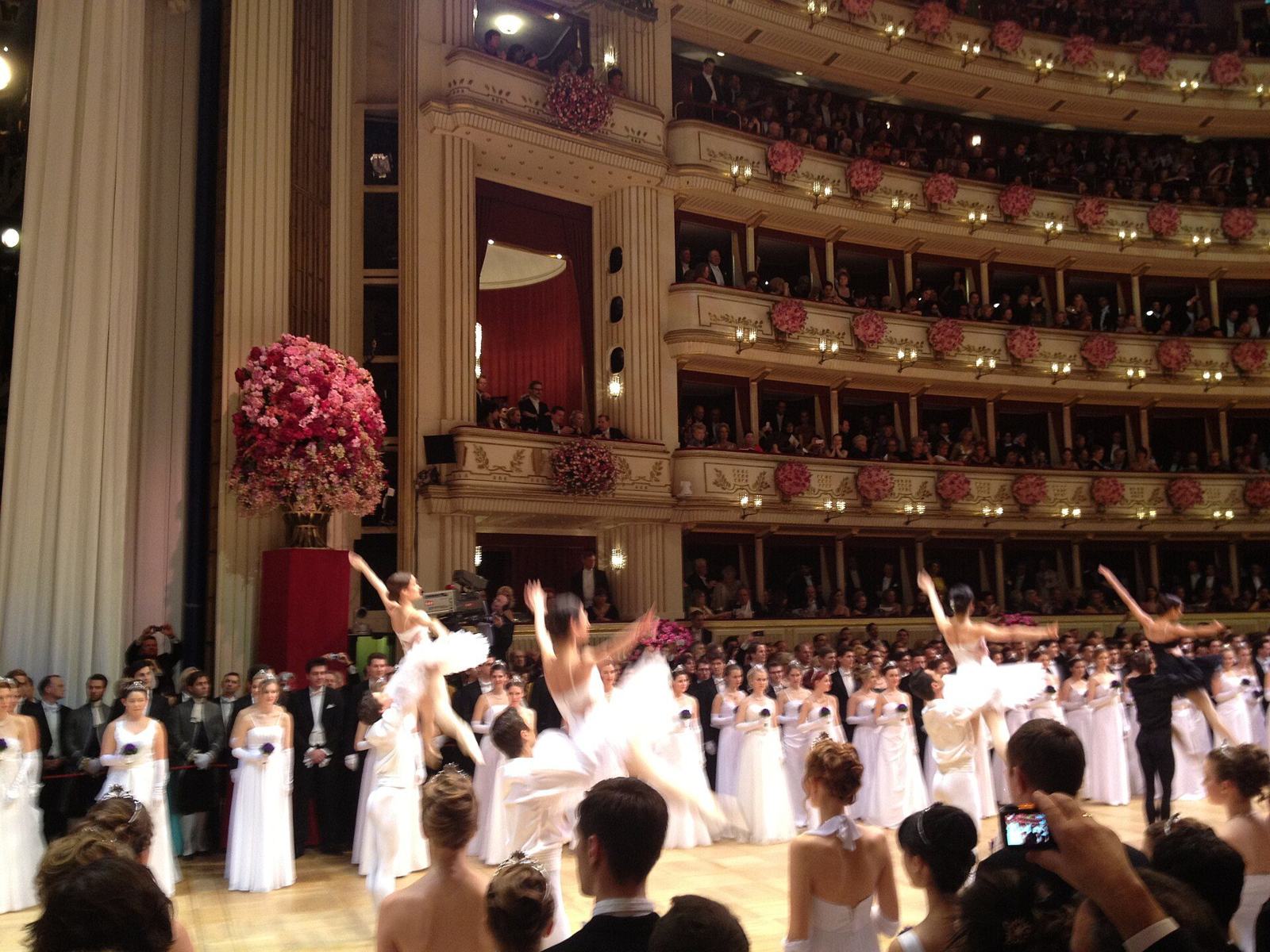
From these nights grew the Viennese ball season, which runs from 11 November to Shrove Tuesday. In the 2023/24 season the Austrian Economic Chamber expected about 540,000 guests at more than 450 balls. Each one follows the same rituals: an opening ceremony, the call “Alles Walzer!” (“Everybody waltz!”) that sends the guests onto the floor, and long after midnight the waltzes and quadrilles of the Strauss family.
The queen of them all is the Vienna Opera Ball. In 1877 Emperor Franz Joseph allowed a “soirée” in the Court Opera, for which Johann Strauss II composed and conducted; the first true Opera Ball took place on 26 January 1935. Interrupted in 1940 by the war, it returned on 9 February 1956 in the rebuilt house and has been cancelled only once since, in 1991. Today about 5,000 guests attend; in 2025, 144 debutante couples opened the ball, and the midnight quadrille remains one of its most loved moments.
The Romantic age produced Austria's first international ballet star. Fanny Elssler (1810–1884), daughter of a valet and copyist of Joseph Haydn, danced as a child at Vienna's Kärntnertortheater, made her Paris Opéra debut in 1834 and in 1836 enchanted Paris with the Spanish cachucha in Le Diable boiteux. Her American tour of 1840–1842 was such a success that she broke her Paris contract to extend it; she retired in 1851.
On 25 May 1869 the new Court Opera on the Ring opened with Mozart's Don Giovanni; the competition brief had demanded a house fit for both opera and ballet. Its great ballet hit was Die Puppenfee (The Fairy Doll), premiered on 4 October 1888 with choreography by Joseph Hassreiter and music by Josef Bayer; it reached its 750th Vienna performance in 1973 and is still in the repertoire. In 1907 Gustav Mahler, the opera's director, defied the ballet master by giving the young Grete Wiesenthal the lead role of Fenella in La Muette de Portici — a scandal that hastened his own resignation.
The 20th century brought a line of strong directors: Margarete Wallmann from 1934; Erika Hanka from 1942 to 1958, who reopened the rebuilt house in 1955 with Giselle; and Aurel von Milloss, who invited Rudolf Nureyev to stage a new Swan Lake in the 1960s. In 2005 the ballet companies of the State Opera and the Volksoper merged into what is now the Vienna State Ballet. Manuel Legris, a former Paris Opera étoile, led it from 2010 to 2020, followed by Martin Schläpfer, and on 1 September 2025 the Italian ballerina Alessandra Ferri took over as director.
In 1908 Grete Wiesenthal (1885–1970), who had left the Court Opera ballet, appeared with her sisters Elsa and Berta at the Cabaret Fledermaus — and danced The Blue Danube as nobody had danced it before: barefoot, flowing and free, with the swinging, whirling body at the centre rather than ballet's steps. The Wiesenthal sisters helped carry Viennese dance from Romantic ballet into the freer forms of the 20th century; Grete opened her own school in 1919, became a professor at the Vienna Academy of Music in 1934 and created ballets such as Der Taugenichts in Wien.
Gertrud Bodenwieser (1890–1959) taught mime and dance at the Vienna Academy of Music and Performing Arts from 1921 to 1938 and became one of the leading voices of Ausdruckstanz, the German-language expressive dance; her best-known work, Dämon Maschine, turned dancers into the parts of a relentless machine. In 1934 her group toured Japan, the first European dance group to do so.
Around them a whole generation took shape. Rosalia Chladek (1905–1995) taught at the Hellerau school, which moved in 1925 to Laxenburg near Vienna, led its dance group until 1938, won second prize at the great international choreography competition in Paris in 1932 with Les Contrastes and developed a teaching method still known as the Chladek system. Hilde Holger founded her New School for Movement Arts in the Palais Ratibor in 1926, and Gertrud Kraus, a Bodenwieser pupil, led her own company. The Theatermuseum's 2019 exhibition “Alles tanzt” called these women the pioneers of European dance modernism.
While Vienna waltzed, many old village dances were fading. At the end of the 19th century enthusiasts began to study and write down rural dances that survived only in fragments — so that, as the UNESCO inventory notes frankly, folk-dance culture as it is practised today is largely an urban creation of the late 19th and early 20th centuries.
The key figure was the Viennese schoolteacher Raimund Zoder (1882–1963). From 1900 he collected folk songs, dances and music in the Alpine regions, founded the Lower Austrian Folk Song Archive and was the first to write down dance figures and tie them to the dance's leading melody. His collections — Altösterreichische Volkstänze (1924–1927) and the three volumes of Österreichische Volkstänze (1946–1955) — became the backbone of the revival, and between the two world wars the Austrian state actively supported folk dancing together with folk song and traditional costume.
After the Second World War the movement organised itself. Vienna's folk-dance groups formed a working association in 1949, which runs the Wiener Kathreintanz — the ball held on the last Saturday before St Catherine's Day (25 November), because “Kathrein stellt den Tanz ein”: Catherine puts an end to dancing until after Advent. In 1956 the Federal Association of Austrian Folk Dance (BAG) was founded as the national umbrella body; it unites associations from all nine federal states and South Tyrol and publishes the magazine Der fröhliche Kreis.
The annexation of Austria by Nazi Germany in March 1938 destroyed Vienna's dance modernism, a scene led largely by women, many of them Jewish; its ideas lived on mainly in exile. Gertrud Bodenwieser fled with a handful of students, first to Colombia and then to Australia, where in 1939 she founded the Bodenwieser Ballet in Sydney, which toured as far as South Africa and India; her husband, the director Friedrich Rosenthal, died in Auschwitz in 1942. Hilde Holger escaped to India in 1939 and opened a school in Bombay in 1941.
Others had left earlier or helped from within. Gertrud Kraus emigrated to Mandatory Palestine in the 1930s, settled in Tel Aviv and became one of the pioneers of modern dance there, winning the Israel Prize in 1968. Grete Wiesenthal, who stayed in Vienna, helped Jewish friends such as Lily Calderon-Spitz reach Britain in 1938.
The regime also bent folk dance to its purposes: it used Volkstanz to stage the ideal of a national “people's community” and favoured group dances over couple dances, until most of this cultural work stopped in 1943. The dancer Hanna Berger, who had trained with Mary Wigman, joined the communist resistance in Berlin, was arrested in 1942 and escaped during an air raid in 1943 while being transferred to the Ravensbrück camp. The Opera Ball ended in 1940, and in March 1945 the State Opera itself was largely destroyed by bombs.
Rebuilding began at once. In October 1945 Hanna Berger was appointed dance teacher at the Vienna Academy of Music, where Grete Wiesenthal became director of artistic dance the same year; Rosalia Chladek, who had founded a training course for stage dance at the Vienna Conservatory in 1942, led it until 1952 and from 1962 to 1977 ran a university course in modern dance education based on her system.
On 5 November 1955 — weeks after the State Treaty restored Austria's independence — the rebuilt State Opera reopened with Beethoven's Fidelio, and the ballet followed with Giselle and the world premiere of Boris Blacher's Der Mohr von Venedig. On 9 February 1956 the first Opera Ball of the Second Republic filled the house with waltzing couples again.
The waltz also found a global stage. The Vienna Philharmonic's Strauss concert, first given on 31 December 1939, became the New Year's Concert in the Golden Hall of the Musikverein; The Blue Danube was first played as an encore in 1945, and since 1958 it has closed the concert with the Radetzky March. Today the broadcast reaches audiences in more than ninety countries, and dancers of the Vienna State Ballet waltz through Schönbrunn Palace and the Opera in its filmed interludes.
In 1984 the Austrian cultural manager Karl Regensburger and the Brazilian dancer and choreographer Ismael Ivo launched the International Dance Weeks Vienna: twenty workshops taught by six teachers at a university sports centre. In 1988 a performance programme was added and the festival became ImPulsTanz – Vienna International Dance Festival; in 1996 it created danceWEB, a scholarship programme that brings about sixty young dance professionals from more than forty countries to Vienna every summer.
Since 2001 the festival has opened in the courtyard of the MuseumsQuartier, and today it presents more than fifty productions and over two hundred workshops and research projects each summer, making Vienna one of Europe's great meeting points for contemporary dance. The same year the Tanzquartier Wien opened in the MuseumsQuartier as a year-round centre for contemporary dance and performance, combining stage, training, theory and research.
Austria's national inventory of intangible cultural heritage, kept by the Austrian Commission for UNESCO, includes several dance traditions. The Austrian folk-dance movement was inscribed in 2010 for the whole country, and in November 2017 “The Viennese Waltz – played, danced and sung” followed: the inventory notes that The Blue Danube greets every New Year, that balls open with the call “Alles Walzer” and that in many regions the bride's waltz belongs to every wedding.
Regional traditions are listed too: the Landler of the Innviertel in Upper Austria (2013), danced by the old rural fellowships of young men with its yodel ending, the Almer; and the sword dance of the Dürrnberg salt miners near Hallein (2011), performed for about 500 years. One Austrian dance custom is on UNESCO's international Representative List: the Schemenlaufen of Imst in Tyrol (2012), a carnival held about every four years in which masked pairs perform a dance of jumps and bows, the larger figures carrying bells of up to 35 kilograms.
Dance is also studied: in 1975 the dancer and dance scholar Friderica Derra de Moroda left her renowned dance library to the University of Salzburg, the origin of today's Derra de Moroda Dance Archives. And it is danced in every register — at more than 450 Viennese balls a year, at village fairs and Kathrein dances, on the opera stage and in the workshops of ImPulsTanz.