··EN · ES · FA
Tap a region to read its story
Swipe the timeline
An in-depth essay tracing Argentine dance through Indigenous histories, rural societies, the Atlantic port, tango and contemporary communities.
Long before modern Argentina existed, diverse peoples inhabited mountains, plains, forests and southern territories. Their expressive life brought together movement, music, seasonal gatherings and community responsibilities, but each people had its own practices. Andean forms visible today in the northwest exist within a wider transnational cultural world. We should not invent an unbroken line from ancient ceremonies to every modern folk dance: continuity, adaptation, suppression and revival demand separate evidence.
Across rural society, dances such as gato, escondido, pericón, zamba and chacarera took shape through shifting local customs, traveling musicians and gatherings. The gaucho became a powerful national symbol, yet Argentine rural communities were far more diverse than this single image. Footwork, handkerchief courtship, group patterns and guitar-led music express social relationships. The malambo, celebrated for intricate zapateo, places particular attention on the skill and rhythm of the feet.
African-descended communities made lasting contributions to the musical and social history of the Río de la Plata. Candombe-related practices, percussion and neighborhood celebrations form part of that story, even when national narratives once minimized their presence. In Buenos Aires and Montevideo, migration and encounters among Afro-descended residents, working-class communities and European immigrants helped shape changing urban music and social dancing. Each influence deserves acknowledgment without reducing tango to one origin.
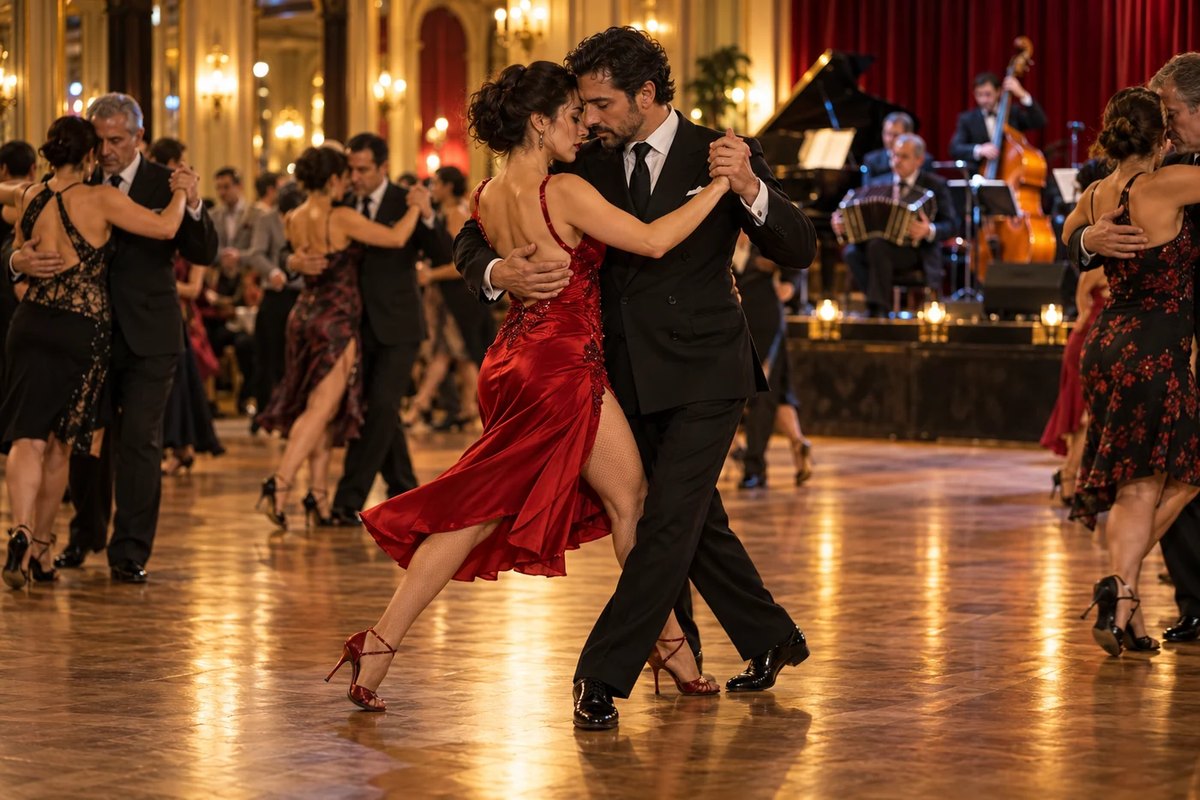
Around the Río de la Plata, tango grew into a complex language of embrace, improvisation, musical phrasing and social encounter. Its history belongs to both Buenos Aires and Montevideo; UNESCO inscribed tango in 2009 as a shared intangible cultural heritage of Argentina and Uruguay. Tango is more than stage lifts and dramatic poses: the social milonga, the walking conversation between partners, orchestras, singing and neighborhood dance floors remain central. Its forms continue to change, including roles and approaches that question conventional gender expectations.
During the twentieth century, performers, scholars and institutions collected, arranged and taught regional repertoires. Andrés Chazarreta’s presentations helped move northwestern folklore onto metropolitan stages, while festivals such as Cosquín made collective identities visible to a wider audience. A stage choreography can preserve recognizable steps, yet it does not always capture the flexibility of a family gathering or village celebration. DANZO distinguishes a staged interpretation from the living community practice from which it draws.
Argentina’s dance story is still being written. Chamamé in Corrientes unites music, close-partner dancing and gatherings throughout the Litoral; UNESCO recognized it in 2020. Córdoba’s cuarteto developed its own festive musical and dance culture and received UNESCO recognition in 2025. Murga porteña animates neighborhoods with rhythmic steps and percussion, while cumbia, hip-hop and contemporary dance transform public and artistic spaces. These are not lesser afterthoughts to tango: they are living expressions of a changing society.
A national dance atlas must document who performs a tradition, in what setting, and how performers themselves describe its meaning. Oral histories, community perspectives and credited audiovisual records are as important as institutional lists. A dance may be celebrated publicly in one context and reserved for specific participants in another. Research also needs to recognize the shared cultural life of neighboring countries.