··EN · ES · FA
Tap a region to read its story
Swipe the timeline
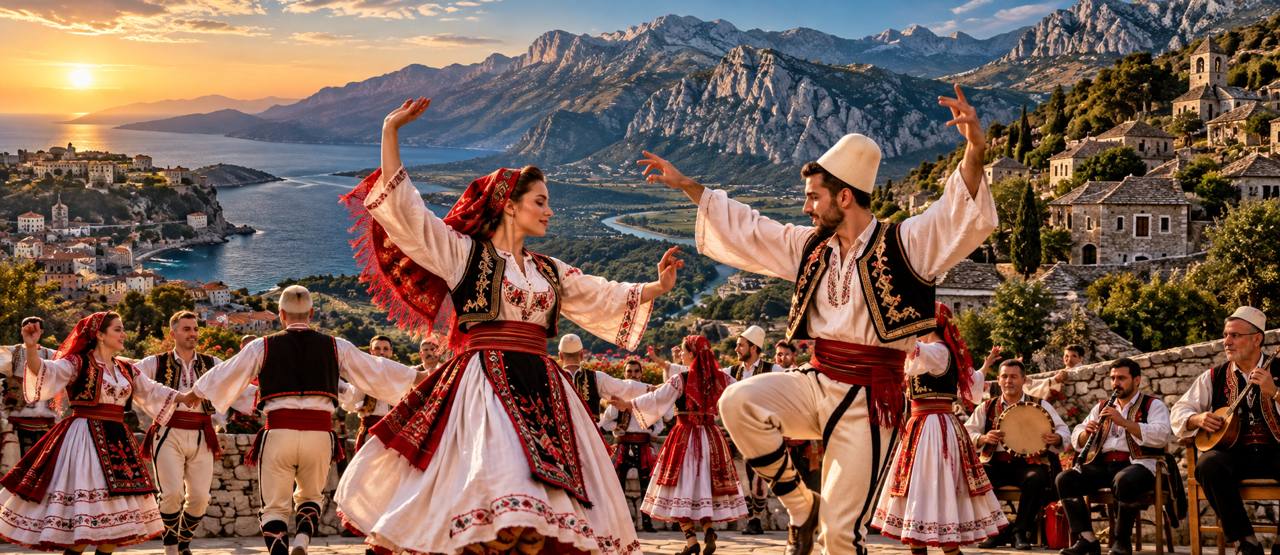
Albania’s cultural geography is richer than a simple north–south division. Mountain routes, river valleys, cities and cross-border communities all shaped how people sing, celebrate and dance. In the northern highlands, festive partner dances such as K’cimi of Tropojë feature expressive movements; in southern communities, circle and line formations coexist with distinctive vocal traditions. The following regions are an introduction to living diversity, not fixed borders around a single choreography.
Northern Albania includes mountainous districts such as Tropojë and areas around Shkodër. Dance gatherings are closely connected with weddings, family events and village celebrations, where drumming and the physical exchange between dancers can be as important as formal steps.
K’cimi of Tropojë is an especially well-documented example: participants often dance face to face without touching, raising and lowering their arms while moving around each other. The dance may include men, women and children, and some women wave a red handkerchief.
The dance was inscribed by UNESCO in 2024, with an emphasis on learning through observation and participation. Other northern communities maintain their own dance repertories; Tropojë should not be treated as a substitute for the entire north.
Central Albania connects the capital Tirana with surrounding towns, coastal settlements and inland communities. Dance life here includes family celebrations, cultural programs, folk ensembles and a growing variety of contemporary studios.
A visitor to Tirana may encounter a staged folk performance one evening and a salsa, ballet or hip-hop class the next day. These activities serve different audiences but share the city’s role as a meeting place for performers from many regions.
Rather than assigning a single dance to central Albania, DANZO highlights the mixture of regional influences and the importance of schools and cultural institutions in passing dance on to new generations.
Southern Albania includes the stone cities and mountain valleys around Gjirokastër, the Pogon area and coastal communities. Many local dances use linked formations, with dancers coordinating their steps in lines or circles during communal celebrations.
Pogonishte is associated with the Pogon region, but the form seen in a stage show may differ from versions danced at social gatherings. As with other Balkan dance traditions, names and patterns may cross linguistic and geographic boundaries.
Southern Albanian folk iso-polyphony, recognized by UNESCO in 2008, is a vocal tradition that accompanies many social occasions. It helps explain the region’s musical environment, but it should not be confused with a dance itself.
Albanian cultural life is not limited to the borders of Albania. Albanian-speaking communities in Kosovo, North Macedonia, Montenegro and the wider diaspora maintain dance and music traditions that connect families across generations.
Shota is particularly associated with Kosovo Albanian dance performances. It is often presented at celebrations and cultural events, but there are different arrangements and stage interpretations. Describing its regional context respects the communities who carry the tradition.
When dances move with migrating communities, they may acquire new teaching methods, musical accompaniments and performance settings. The resulting variety is part of the living story of Albanian cultural identity.