··EN · ES · FA
Tap a region to read its story
Swipe the timeline
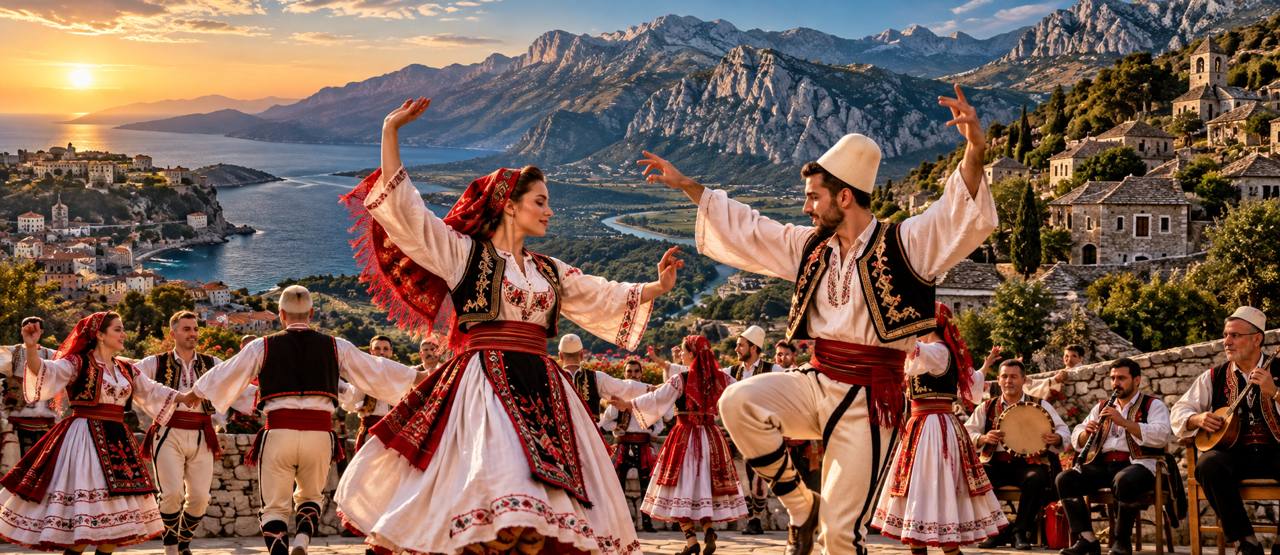
In Albania, dance is not confined to a theatre. It belongs to family weddings, village celebrations, gatherings in mountain communities and festivals where musicians and dancers represent their home regions. The steps, instruments and costumes vary from north to south, and the traditions have changed as communities migrated and as folk performances moved onto the stage. This history follows that journey: from participatory dances to professional ensembles, from regional singing traditions to international recognition of living heritage.
In many Albanian communities, dancing marks the moments when people come together: weddings, birthdays, village celebrations and seasonal gatherings. Guests may join a line or circle, follow a leader, or dance in pairs. The arrangement is social as well as artistic, allowing participants of different ages to share a familiar rhythm.
These dances are learned in everyday life as much as in formal classes. A child may first observe relatives at a celebration, then try the steps beside experienced dancers. Because the setting is participatory, movements can differ between families, villages and generations without losing their importance to the community.
The mountains of northern Albania have fostered distinctive dance practices. In Tropojë, k’cimi is performed in festive gatherings and ceremonies, often with dancers facing one another without touching. Their arms rise and fall as they move around each other to the rhythm of drums; participation is not restricted to a single age group.
UNESCO inscribed K’cimi dancing of Tropojë on its Representative List of the Intangible Cultural Heritage of Humanity in 2024. The nomination emphasizes transmission through family and community participation. Recognition draws attention to the people who practise the dance rather than freezing it into one stage choreography.
In southern Albania, line and circle dances coexist with distinctive regional singing and instrumental traditions. Dancers may move together through repeating patterns while the music guides changes in pace and expression. The names, steps and social contexts of these dances can vary significantly between neighboring communities.
Albanian folk iso-polyphony is one of the best-known musical traditions of the region. It features interlocking vocal lines and a sustained drone; UNESCO inscribed it in 2008. Although it often accompanies social celebrations where dance also takes place, iso-polyphony is a form of singing, not the name of a single dance.
As folk culture began to be presented in organized festivals, dances that had been performed in villages reached larger audiences. The National Folklore Festival of Gjirokastër began in 1968 and became a major platform for regional songs, dances, costumes and instrumental music. Performers from different areas appear together, making differences in style easier to appreciate.
Stage presentation can help audiences discover a tradition, but it also changes its context. A dance shortened for a festival programme may not look exactly like the longer version performed at a wedding. Both settings matter: one highlights the artistic repertoire, while the other preserves the relationships and occasions in which the dance lives.
Professional ensembles, cultural centers and independent dance schools have helped bring Albanian dances to theatres, competitions and international festivals. Rehearsed stage productions often combine traditional motifs with carefully designed costumes, group formations and musical arrangements. Such productions can celebrate regional identity while presenting a version shaped for performance.
Alongside folk ensembles, Albania’s cities now host studios teaching ballet, contemporary, Latin and street dance. These newer disciplines do not replace regional folk traditions; they coexist with them, giving young dancers multiple artistic paths. Community elders, teachers and performers all play different roles in keeping movement knowledge available.
Albanian-speaking communities extend beyond the borders of the Republic of Albania, including Kosovo and communities elsewhere in the Balkans. Dance repertories travel with families, cultural groups and performers, sometimes changing as they meet new audiences. Shota is especially associated with Kosovo Albanian cultural performance and should be introduced with that specific regional context.
Diaspora festivals, weddings and cultural associations can preserve familiar songs and dances while adapting them to new spaces. Responsible descriptions name the communities involved and avoid suggesting that every performance represents all Albanian speakers in the same way.